Molecular Dust and Ancient Shale
Just above the cliffside, a faint green veil of airglow illuminates Earth’s upper atmosphere as excited oxygen and nitrogen atoms release solar energy absorbed during daylight. High above this atmospheric reaction, the galactic core shines with an interstellar atomic process. Vibrant magenta patches mark vast star-forming nurseries where intense ultraviolet radiation from newborn stars strips electrons from surrounding hydrogen gas, emitting characteristic pink light as the electrons recombine.
The dark, shadowy ribbons dividing the Milky Way look like empty voids, but they are actually dense, light-blocking lanes of interstellar dust particles. These molecular clouds act as cosmic reservoirs, holding the heavy elements and mass necessary to forge future solar systems. Below, streamflow relentlessly carves through 380-million-year-old Devonian shale, creating a stark physical pairing: liquid water eroding ancient bedrock while cosmic dust quietly accumulates the ingredients for unborn worlds.
This quiet arch of stars conceals massive kinetic energy across the cosmic scale. Driven by mutual gravitational attraction, the Milky Way and the nearby Andromeda galaxy are closing in on each other at 250,000 miles per hour. In roughly four billion years, their impending merger will combine trillions of stars into a single massive galaxy, permanently restructuring the night sky above Cayuga Lake beyond recognition.
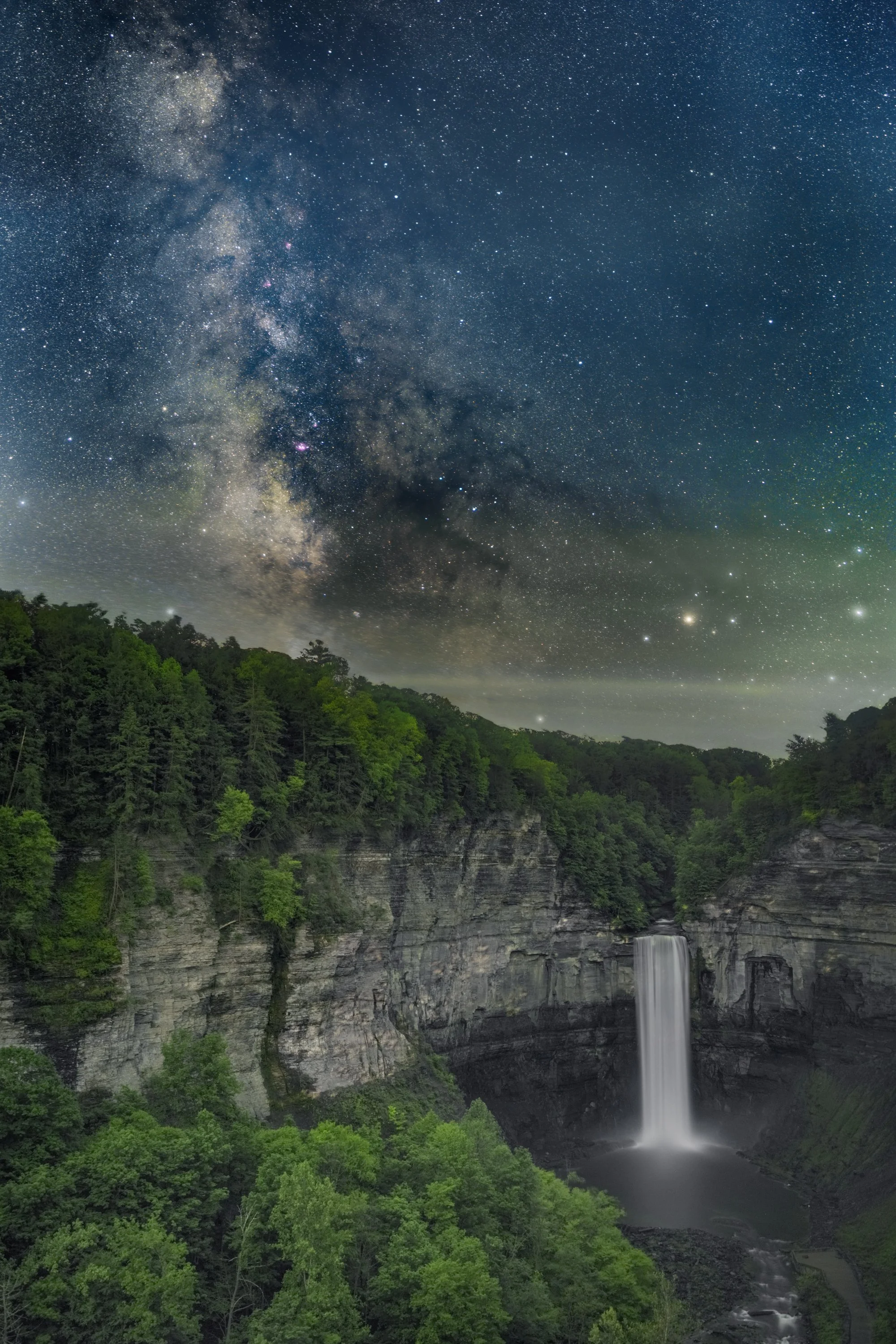
Milky Way Galaxy above Taughannock Falls in Upstate NY
Bates, D. R., "The Green Light of the Night Sky", Planetary and Space Science (1981).
Osterbrock, D. E., & Ferland, G. J., "Astrophysics of Gaseous Nebulae and Active Galactic Nuclei", University Science Books (2006).
van der Marel, R. P., Besla, G., Cox, T. J., Sohn, S. T., & Anderson, J., "The M31 Velocity Vector. III. Future Evolution of the Milky Way and Andromeda Galaxy System", The Astrophysical Journal (2012).