Deep Time, Ice, and Micro-Refugia: The Science of Watkins Glen
An Ancient Ocean Bed
The bedrock exposed in Watkins Glen formed roughly 380 million years ago during the Late Devonian Period, when a shallow inland sea covered central New York. Fine mud and sand eroded from the rising Appalachian Mountains to the east, settling into alternating layers of crumbly black shale and resistant grey sandstone.
Tectonic Fractures & Hydraulic Plucking
Subsequent continental collisions (the Alleghenian Orogeny) compressed these sedimentary layers, creating dense networks of vertical, grid-like fractures called joint sets. These orthogonal cracks act like pre-scored lines on a chocolate bar. Rather than slowly abrading the hard rock, stream water penetrates these joint planes, dislodging and plucking out whole rectangular blocks during high-flow conditions to form the stepped cascades visible throughout the gorge.
Glacial Carving & Hanging Valleys
During the Pleistocene Ice Age, kilometer-thick glaciers scoured the north-south valleys, creating the deep U-shaped basin now occupied by Seneca Lake. Smaller tributary streams running east-west were eroded far less deeply, leaving them "hanging" high above the newly deepened main valley. When the ice retreated ~12,000 years ago, Glen Creek plunged over this high drop-off, initiating rapid headward erosion that carved the current 300-foot-deep gorge.
Hydrograph "Flashiness"
Bedrock gorge erosion is non-linear; it occurs primarily during extreme, episodic flood events rather than baseline flow. Climate models for the Northeastern United States project a continued shift toward a "flashier" hydrograph, marked by more frequent, high-intensity downpours. Increased peak discharge amplifies shear stress and hydraulic pressure on stream beds, accelerating rate-of-block plucking and landscape alteration.
Gorges as Climate Microrefugia
Beyond their geomorphic interest, deep ravines serve as critical microclimatic buffers. High vertical walls, heavy shade, and localized cold-air pooling maintain micro-environments that can remain up to 10°F cooler than the surrounding uplands. These sheltered corridors function as microrefugia, offering environmental stability for temperature-sensitive mosses, rare ferns, and specialized invertebrates as regional macroclimates warm.
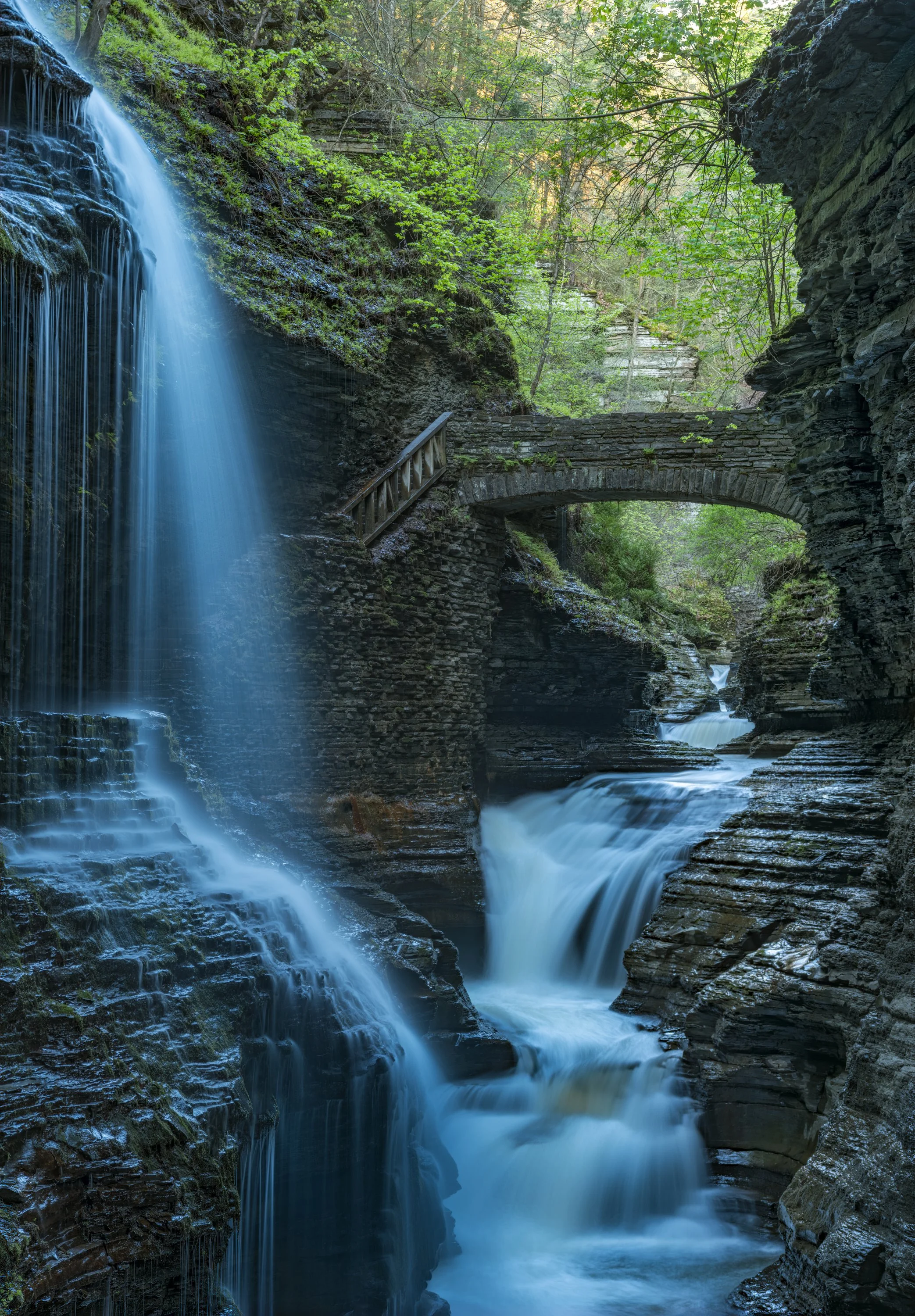
Watkins Glen in the early morning
Jong, B.-T., Delworth, T. L., Cooke, W. F., Tseng, K.-C., & Murakami, H. (2023). Increases in extreme precipitation over the Northeast United States using high-resolution climate model simulations. npj Climate and Atmospheric Science, 6(1), Article 34. https://doi.org/10.1038/s41612-023-00347-w
Wilkin, K., Ackerly, D., & Stephens, S. (2016). Climate change refugia, fire ecology and management. Forests, 7(4), 77. https://doi.org/10.3390/f7040077
Museum of the Earth. (2021). Devonian geology and stratigraphy of the Finger Lakes region. Paleontological Research Institution, Ithaca, NY.