The Vanishing Archive: Icelandic Glaciers and the Global Climate Engine
Standing beneath the soaring icy ramparts of southern Iceland, a small homestead sits at the center of a grand climate paradox. Solar radiation drives steady ice loss, stripping mass from glaciers faster each decade. Yet, this land rests on a dynamic ocean-atmosphere seesaw where warming above can trigger localized cooling below.
Glacial ablation is an engine of relentless mass transfer. As rising atmospheric temperatures melt ancient ice sheets, vast streams of buoyant, fresh meltwater pour directly into the subpolar ocean. This massive freshwater flux dilutes the dense, salty surface waters of the North Atlantic, threatening the physical engine that propels global ocean circulation.
The Atlantic Meridional Overturning Circulation (AMOC) functions as Earth's regional heating system, transporting equatorial warmth poleward. When dense saltwater can no longer sink near the Arctic, this planetary heat engine slows. A weakened ocean conveyor stalls poleward heat transport, counterintuitively shifting southern Iceland toward a far colder local climate equilibrium even as global temperatures rise.
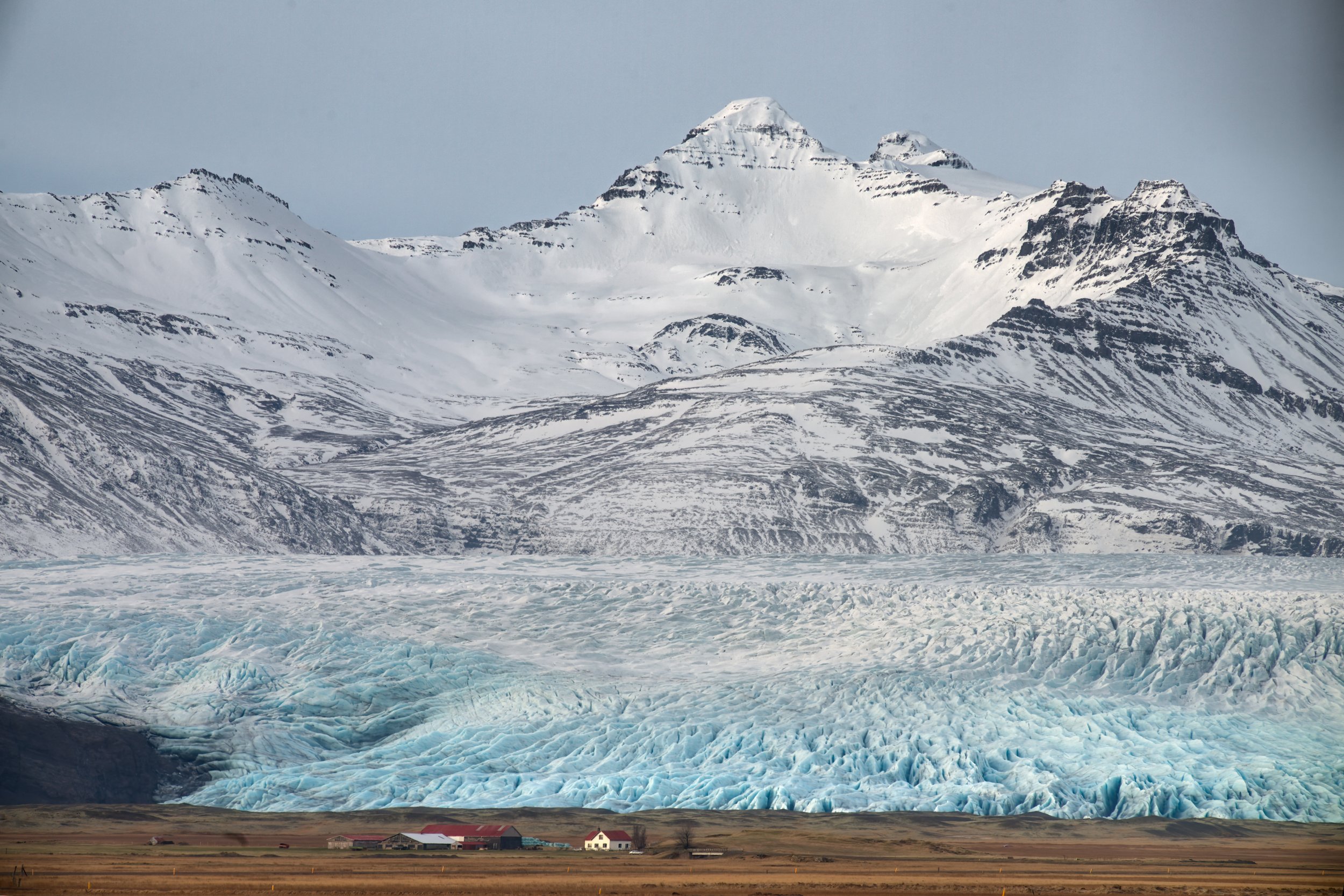
Homestead in southern Iceland
Caesar, L., Rahmstorf, S., Robinson, A., Feulner, G., & Saba, V., Observed fingerprint of a weakening Atlantic Ocean overturned circulation, Nature (2018). https://doi.org/10.1038/s41586-018-0006-5
Noël, B., van de Berg, W. J., Lhermitte, S., & van den Broeke, M. R., North Atlantic Cooling is Slowing Down Mass Loss of Icelandic Glaciers, Geophysical Research Letters (2022). https://doi.org/10.1029/2021GL095697
Liu, W., Fedorov, A. V., & Seager, R., Climate impacts of a weakened Atlantic Meridional Overturning Circulation in a warming climate, Science Advances (2020). https://doi.org/10.1126/sciadv.aaz4876