Life on the edge
Rainfall does not just wash over the landscape; it sinks deep into the earth, slipping through underground rock cracks until it bursts out from vertical cliff faces. Soft shale layers absorb this moving water like a sponge, causing the rock to swell and flake off in tiny, steady crumbling events. This continuous peeling resets the cliff face, preventing soil from ever forming and forcing plants to live directly on bare stone.
This endless airborne spray creates cool, hyper-humid pockets of air that buffer the gorge wall against summer heat. Because the deep gorge walls block direct sunlight, plants clinging to the rock must adapt to perpetual wetness and extreme shade through remarkable cellular tricks:
Custom Solar Panels: Mosses rearrange their internal light-capturing units (chloroplasts) into broad, flat arrays to absorb the faint, scattered light bouncing off the canyon walls.
Microscopic Anchors: Instead of deep roots, these plants use dense networks of tiny hair-like cells called rhizoids that physically glue themselves to wet rock pores.
Sponge-Like Cell Walls: Highly flexible cell walls absorb excess water instantly without bursting, maintaining structural stability under constant saturation.
When heavier storm downpours hit, powerful surges of rushing water wear down the gorge fractures faster. Rather than destroying the habitat, these high-energy flows actually expand the damp rock surfaces. The plant community quickly reorganizes, colonizing fresh rock ledges as soon as the water carves them out.
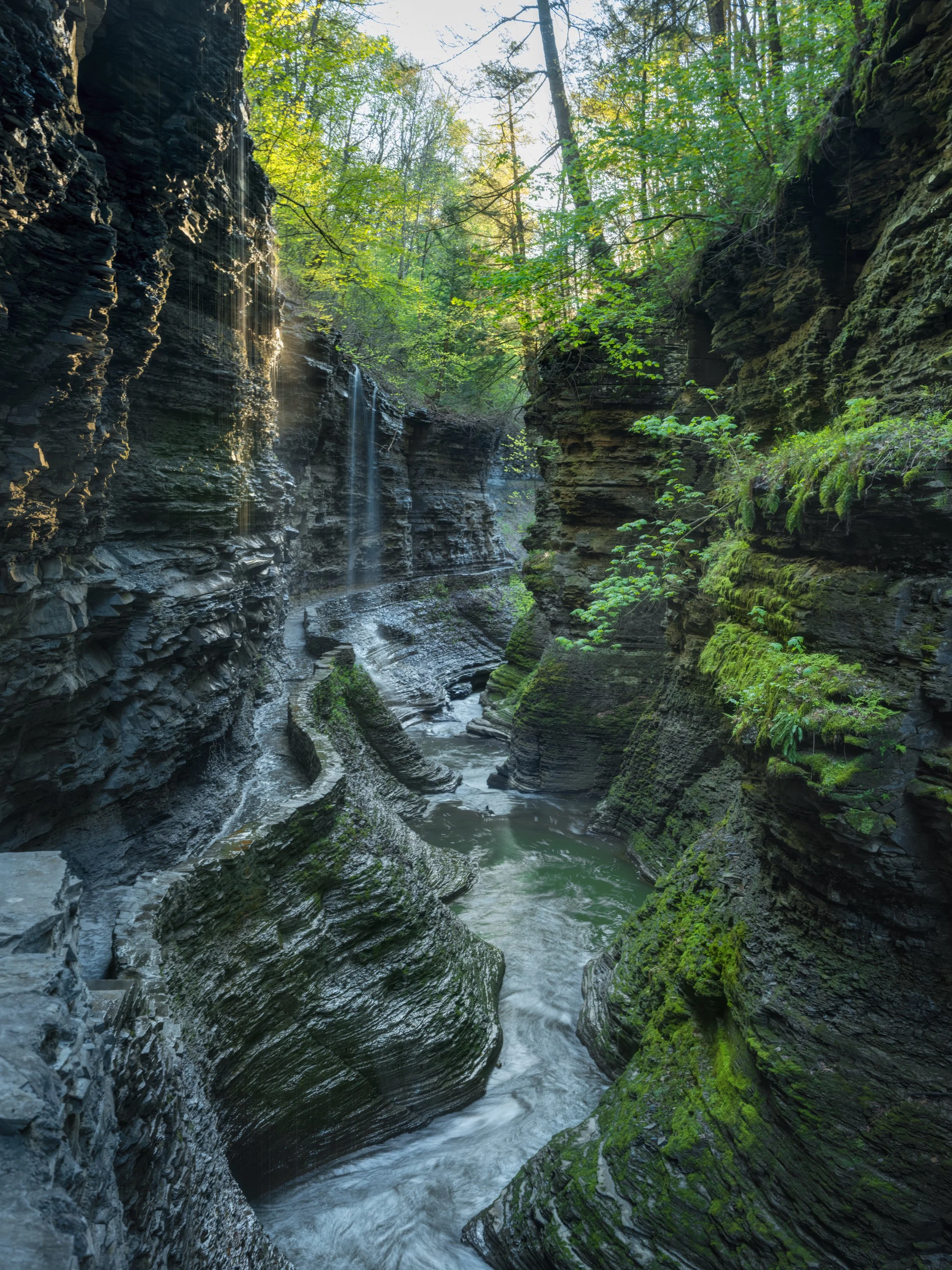
Glen Gorge Trail in the early morning light. Watkins Glen, NY
Glime, J. M., "Bryophyte Ecology: Volume 1, Physiological Ecology", Michigan Technological University and the International Association of Bryologists (2017).
Malamud, B. D., Turcotte, D. L., Guzzetti, F., & Reichenbach, P., "Landslide inventories and their statistical properties", Earth Surface Processes and Landforms (2004).
United States Geological Survey, "Streamflow and Groundwater Interactions in Glaciated Appalachian Plateau Valleys", USGS Scientific Investigations Report (2018).