Crimson Sky: Biomass Aerosols and Optical Filtering
It All Begins Here
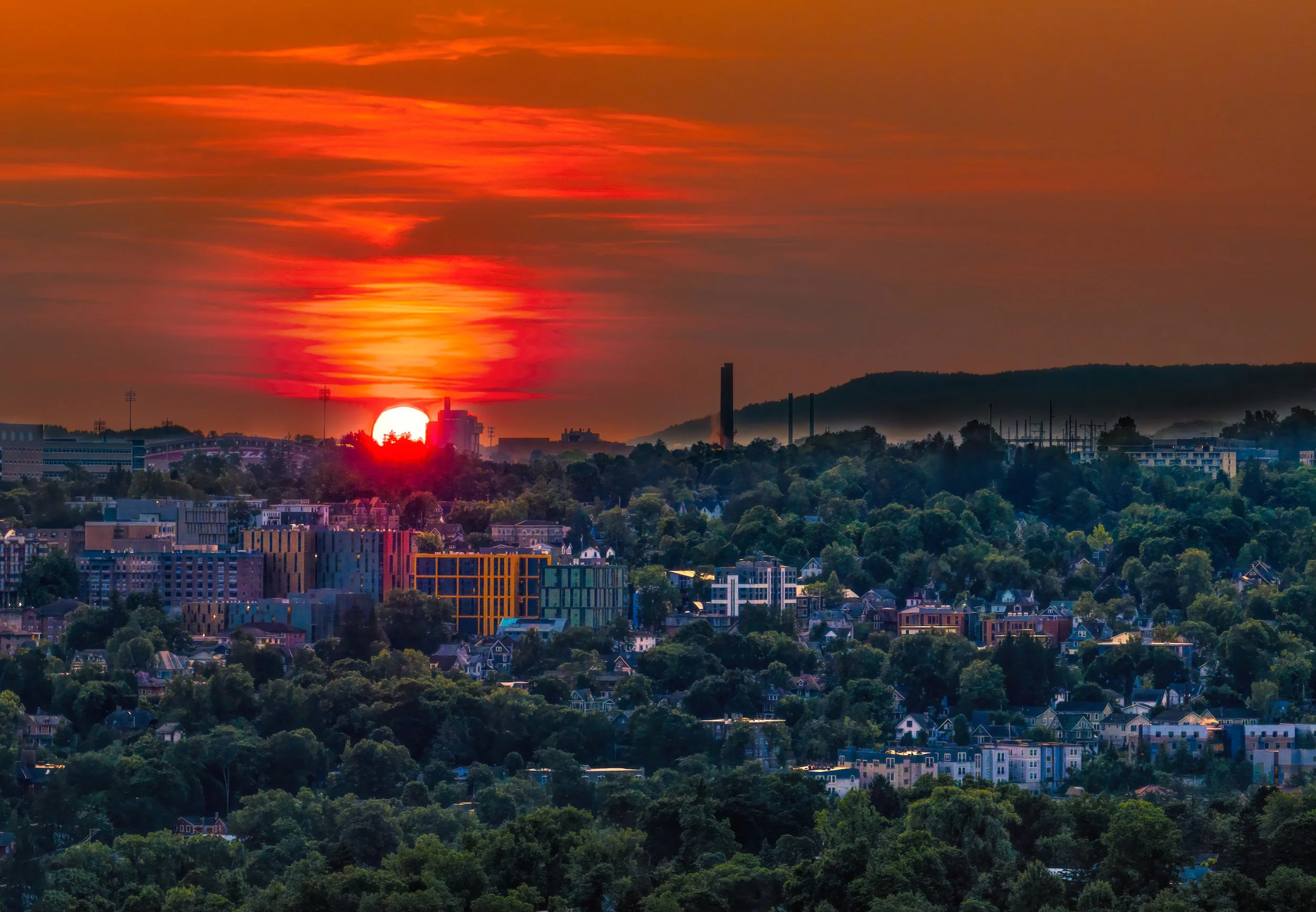
On July 22, 2024, elevated smoke plumes from Canadian wildfires swept across the northeastern United States, transforming the setting sun into a sharp, deep crimson disc. This atmospheric phenomenon is governed by a shift in optical physics paired with changing global climate drivers.
Under typical conditions, air molecules scatter sunlight via Rayleigh scattering, dispersing short blue wavelengths while transmitting warmer yellow and orange hues. Wildfire smoke, however, injects massive quantities of sub-micron fine particulate matter into the atmosphere. Because these combustion aerosols approach the wavelength of visible light, the dominant physical regime shifts to Mie scattering. Over long atmospheric path lengths, this aerosol layer selectively scatters out blue, green, and yellow wavelengths. Simultaneously, high Aerosol Optical Depth (AOD) acts as a natural neutral-density filter, attenuating solar glare enough to reveal the unblurred boundary of the solar disc.
These continent-spanning smoke transport events are increasingly driven by anthropogenic climate change. Canada’s boreal regions are warming at more than twice the global rate, accelerating spring snowmelt and elevating atmospheric Vapor Pressure Deficit (VPD). This prolonged atmospheric drying desiccates forest fuels, doubling the likelihood of extreme fire weather conditions and significantly lengthening the fire season. The resulting high-intensity fires generate powerful convective columns that inject combustion aerosols high into the free troposphere, where strong upper-level steering currents transport them thousands of miles downwind.
What presents visually as a serene sunset is, fundamentally, a physical signature of altered atmospheric chemistry—an optical marker of extreme biomass burning in a warming world.
Sunrise behind Bradfield Hall on Cornell in Ithaca, New York
Kirchmeier-Young, M. C., et al. (2019). "Attribution of the influence of human-induced climate change on an extreme fire season." Earth's Future, 7(1), 2–10.
Reid, J. S., et al. (2005). "A review of biomass burning emissions part II: intensive optical properties of biomass burning particles." Atmospheric Chemistry and Physics, 5(3), 799–825.
Bohren, C. F., & Huffman, D. R. (1983).Absorption and Scattering of Light by Small Particles. John Wiley & Sons.