A Glacial Engine Disguised as a River
Despite its name, the East River is a saltwater tidal strait carved 12,000 years ago by the retreating Laurentide Ice Sheet. Four times daily, gravitational forces from lunar tides churn immense volumes of seawater between Long Island Sound and Upper New York Harbor. Forced through a narrow bedrock channel at speeds exceeding five knots, these intense currents generate relentless shear stress. This kinetic force sweeps away fine sediment, keeping the exposed bedrock floor scoured clean—a hydrodynamic flushing that preserves deep channels essential for marine navigation.
This fluid motion drives New York's coastal climate. Millions of gallons of seawater act as a massive thermal battery, absorbing summer heat and radiating it back through winter. When frigid continental air collides with this warm estuarine water, dense advection fog blankets the shoreline. This continuous thermodynamic exchange elevates winter temperatures by several degrees compared to inland regions, insulating Manhattan and Brooklyn against harsh freeze cycles.
However, the dynamic strait that tempers New York's climate also exposes it to shifting baseline risks. Accelerated ocean thermal expansion and ice sheet melt are projected to elevate regional sea levels significantly over the next century. Higher baseline waters mean routine lunar tides will increasingly encroach on low-lying waterfronts, transforming former storm-surge anomalies into persistent flooding hazards across coastal Brooklyn and Manhattan.
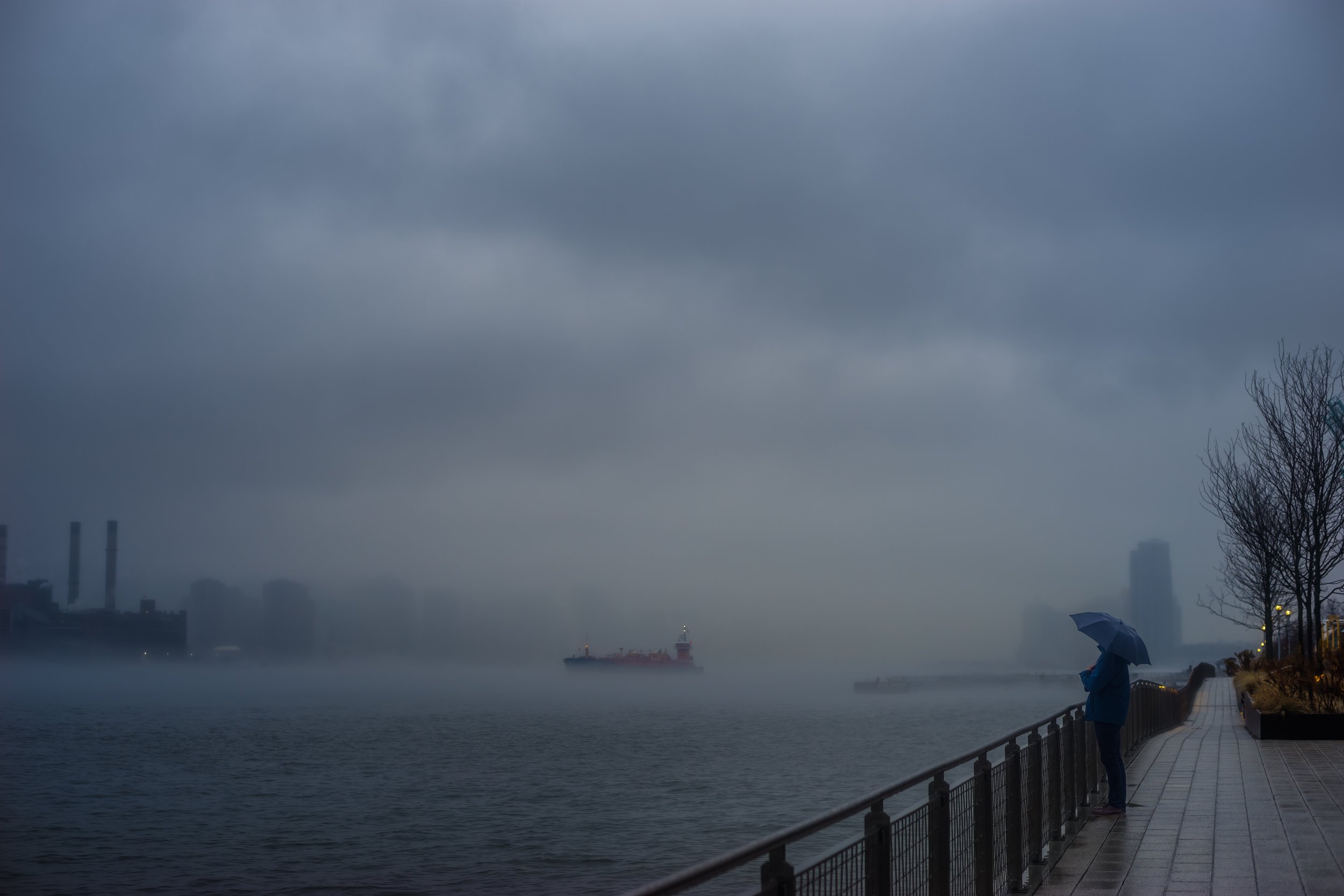
A foggy winter morning on the East River in Brooklyn, NY
National Oceanic and Atmospheric Administration, "Tides and Currents in the East River Tidal Strait," NOAA Technical Report (2019).
New York City Panel on Climate Change, "NPCC3: Climate Risk Information 2019 Report," Annals of the New York Academy of Sciences (2019).
Geological Society of America, "Deglacial History and Bedrock Geomorphology of New York Harbor," GSA Special Papers (2016).