Atmospheric Optics and Leaf Chemistry
At dawn, low-angle sunlight traverses a maximum thickness of Earth's atmosphere, scattering shorter blue wavelengths away and saturating the horizon in long red and golden light. This golden illumination hits a forest undergoing a coordinated biochemical transition. As green chlorophyll decomposes, yellow carotenoid pigments that were masked all summer are exposed.
Trees simultaneously execute a second, energy-intensive chemical strategy: burning stored sugars to synthesize red anthocyanins from scratch. These new red pigments serve as vital sunscreen, protecting vulnerable leaf tissues against volatile late-season weather while trees harvest leftover nutrients. The low morning sun selectively amplifies both carotenoid yellows and anthocyanin reds, turning the valley into a natural optical filter.
Below the canopy, the valley floor is built by fluid dynamics and mass transfer. Streams cascading through steep shale gorges carry massive loads of gravel, silt, and sand from upland erosion. The moment these turbulent waters reach Cayuga Lake’s flat level, they shed kinetic energy and drop their sediment payload, forming the flat delta that city dwellers walk on today.
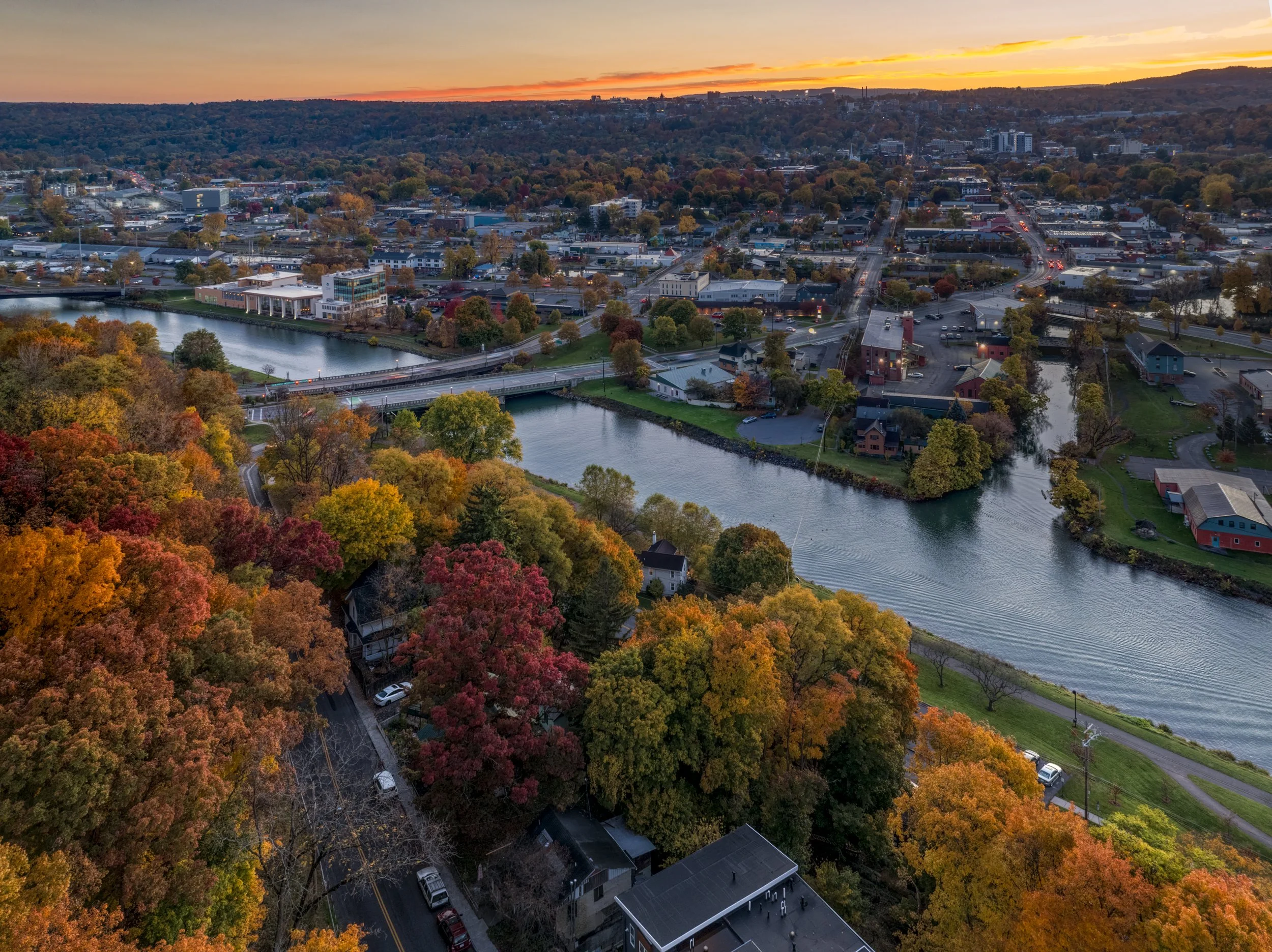
Fall foliage by the light of dawn in Ithaca, NY
Archetti, M., et al., "Unraveling the Evolution of Autumn Colours: An Interdisciplinary Approach", Trends in Ecology & Evolution (2009).
Feild, T. S., Lee, D. W., & Holbrook, N. M., "Why Leaves Turn Red in Autumn: The Photoprotection Hypothesis Revisited", Oecologia (2001).
Miller, G. A., & Karwan, D. L., "Sediment Transport Dynamics in Glaciated Finger Lakes Watersheds", Journal of Hydrology (2017).