Cosmic Collisions, Space Weather, and Planetary Timescales
Captured over Stewart Park at the head of Cayuga Lake, this scene records a rare convergence of space weather, atomic excitation, and regional geography. The luminous display results from charged solar wind particles, primarily high-energy electrons, accelerated down Earth's geomagnetic field lines into the thermosphere:
At altitudes of approximately 60 miles (100 km), incoming energetic particles excite neutral atomic oxygen. As these atoms decay back to their ground state, they emit photons at a wavelength of 557.7 nm, producing the dominant green glow. At lower altitudes with higher atmospheric density, high-energy collisions ionize molecular nitrogen, producing deep purple and violet emission bands along the lower fringes of the curtain.
Because Ithaca sits at approximately 42.4°N geographic latitude (roughly 52°N geomagnetic), the auroral oval remains well to the north under baseline conditions. Viewing an aurora from Upstate New York requires severe coronal mass ejections (CMEs) capable of compressing Earth’s magnetosphere, events that align primarily with the peak phase of the 11-year solar cycle.
While 11-year solar cycles govern short-term space weather, Earth's long-term natural climate shifts are driven by Milankovitch cycles—cyclical variations in Earth's orbital eccentricity, axial tilt (obliquity), and precession. Operating over cycles ranging from 21,000 to 100,000 years, these orbital wobbles alter seasonal solar radiation distribution and dictate glacial-interglacial transitions.
Crucially, natural orbital forcing unfolds across centuries and millennia. In contrast, modern anthropogenic greenhouse gas emissions alter Earth's radiative equilibrium at an unprecedented velocity, driving global climate shifts within single human lifespans rather than astronomical epochs.
The Northern Lights occur when solar wind strikes Earth's magnetosphere. Upstate New York sits at a low geomagnetic latitude, making local auroras rare outside peak solar cycle activity. The glowing green sky overhead is atomic oxygen releasing photons 60 miles up, while the lower purple fringes mark energetic solar collisions with atmospheric nitrogen.
Auroras illuminate the night sky when charged solar particles collide with upper atmospheric gases. Because Ithaca lies south of the magnetic pole, seeing them here requires major solar storms during peak solar cycle activity. Remarkably, the brilliant green light over Cayuga Lake requires nearly a full second for excited oxygen atoms to release photons.
Earth’s climate and sky displays are driven by cosmic dynamics. While solar cycles dictate rare Upstate aurora sightings, long-term planetary shifts are governed by Milankovitch cycles—slow orbital wobbles operating over many centuries and millennia. Unlike these gradual natural rhythms, anthropogenic climate change alters our global heat balance at an unprecedented, rapid pace.
The upper atmosphere connects solar forces with Earth's surface. Upstate New York rarely experiences auroras outside solar cycle peaks when geomagnetic storms strike. Meanwhile, global climate responds to different drivers: interacting Milankovitch cycles shape ice ages over many centuries, while rapid climate change warms local waters like Cayuga Lake at an unprecedented modern velocity.
Celestial and geological forces shaped this scene at Stewart Park. Seeing auroras this far south requires intense solar cycle peaks that push geomagnetic storms toward mid-latitudes. Below the shimmering green thermosphere lies Cayuga Lake, a trough carved by continental glaciers, creating a landscape where space physics meets deep Earth history.
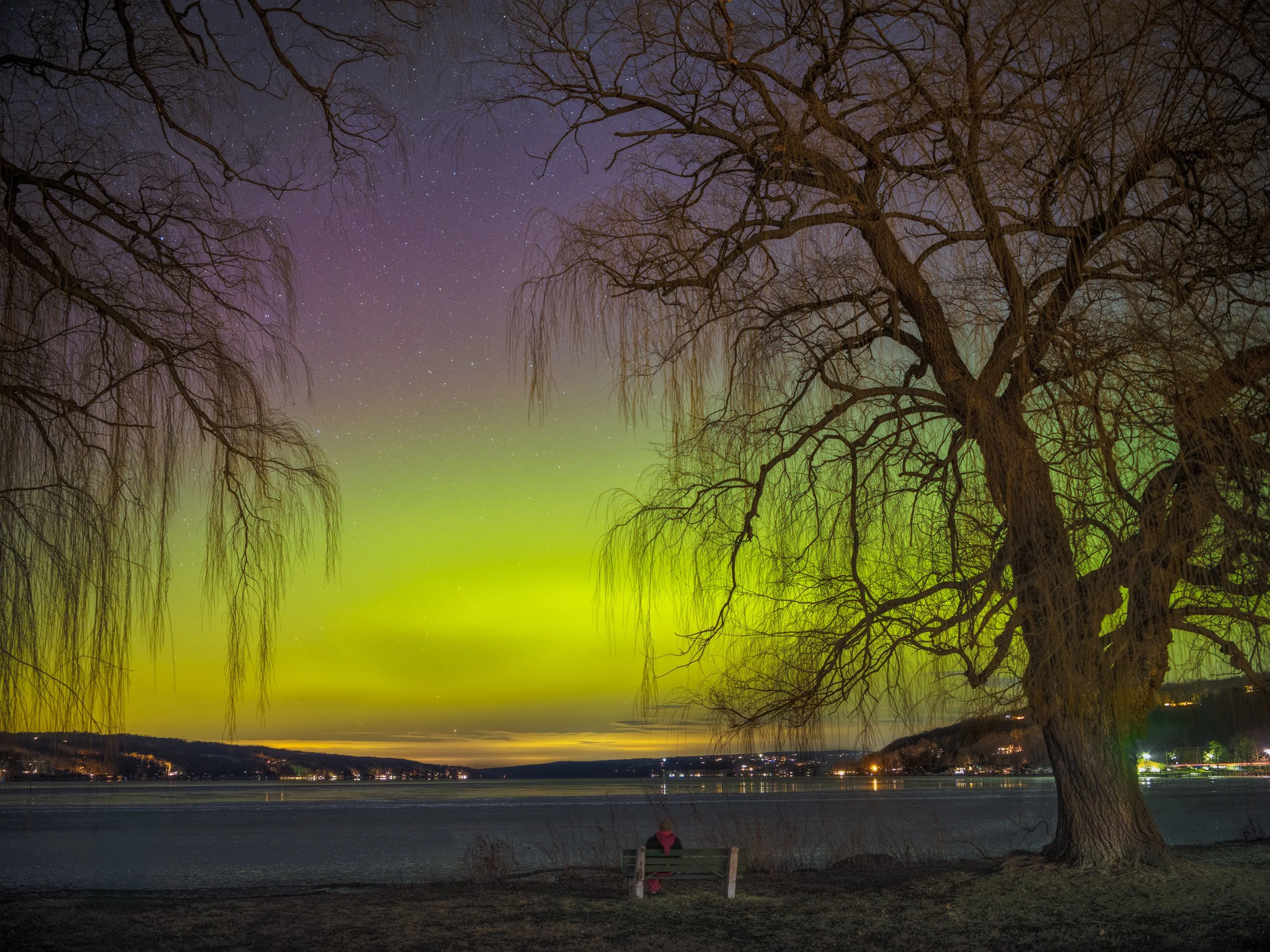
Rare aurora boreolis in Ithaca, NY
Akasofu, S.-I. (2007). Exploring the Secrets of the Aurora. Springer Science & Business Media.
Berger, A. (1988). Milankovitch theory and climate. Reviews of Geophysics, 26(4), 624–657.
IPCC (2021). Climate Change 2021: The Physical Science Basis. Contribution of Working Group I to the Sixth Assessment Report. Cambridge University Press.
Rees, M. H. (1989). Physics and Chemistry of the Upper Atmosphere. Cambridge University Press.