Ghosts in the Machine
When you stand before a venting fumarole, your eyes process motion by integrating visual data over roughly a tenth of a second, merging frantic air currents into a soft, tranquil plume. A high-speed off-camera flash operates thousands of times faster, freezing chaotic atmospheric turbulence in a fraction of a millisecond. By slicing through human optical limits, it exposes the violent, micro-scale fluid dynamics normally lost to motion blur.
Deep beneath the surface, these vents function as massive hydrological heat exchangers rather than direct magmatic exhausts. Torrential rainfall filters miles down through porous basalt rock until it collides with deeply buried, hot volcanic strata. Superheated under intense pressure, that subterranean water flashes upward through narrow fractures, condensing instantly into billions of light-scattering droplets when it strikes the cool night air.
What appears to be a hollow-eyed face emerging from the vapor is a demonstration of pareidolia… an evolutionary reflex that hardwired the human visual cortex to detect facial patterns in random noise to identify potential threats instantly.
Strikingly, the shutter captured this image at 7:48 PM on Halloween. Coincidences like this hold profound weight for us because the human brain is fundamentally an advanced pattern-recognition engine. We instinctively seek out narrative links and shared meaning between unrelated occurrences, weaving physical chance and cultural timing into a single memorable moment.
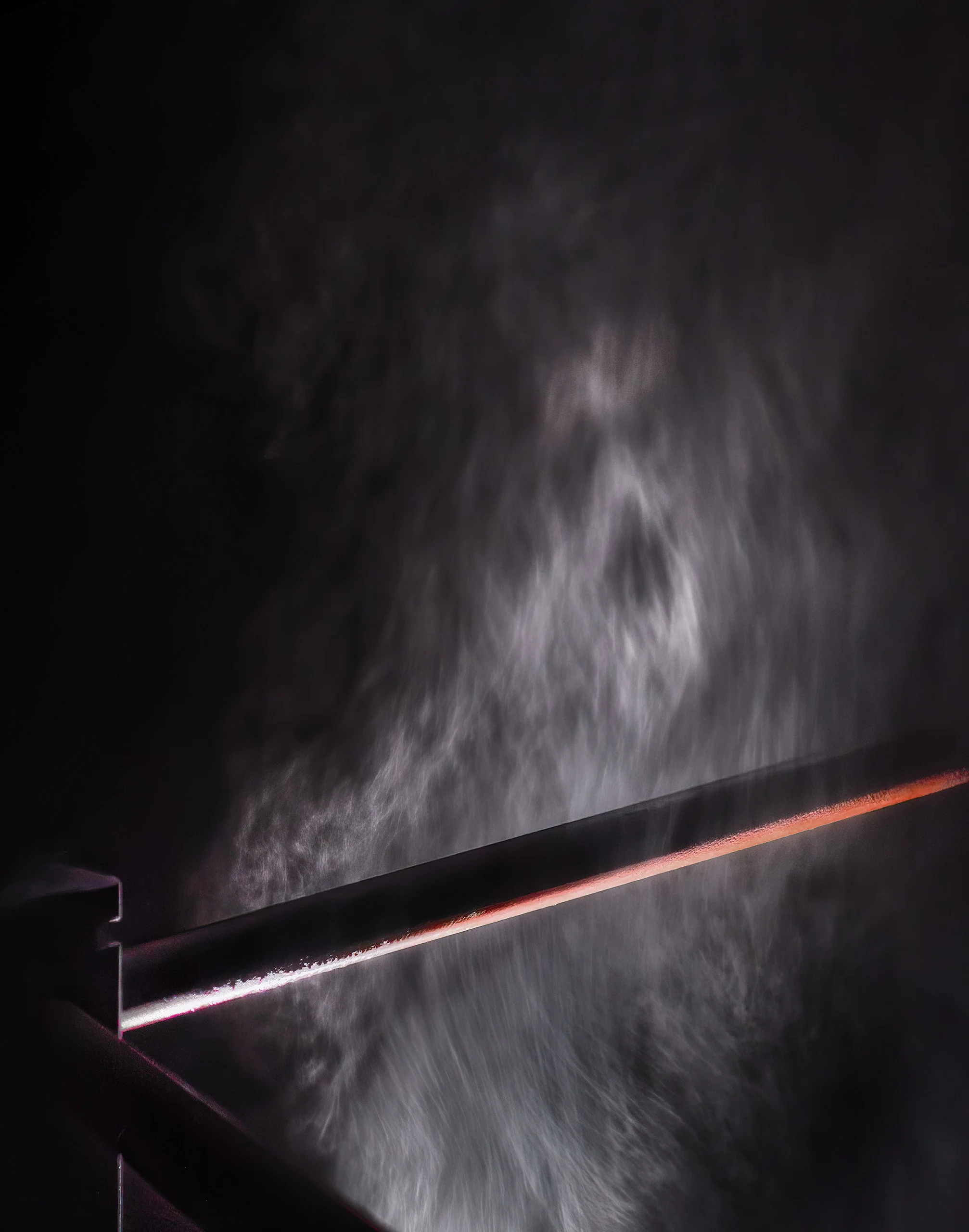
Steam Vents at Hawaii Volcanoes National Park
Gunderson, E. N., "Fluid Mechanics and Visual Perception of Turbulent Flows," Annual Review of Fluid Mechanics (2014).
Liu, J., Li, J., Feng, L., Li, L., Tian, J., and Lee, K., "Seeing Jesus in Toast: Neural and Behavioral Correlates of Face Pareidolia," Cortex (2014).
United States Geological Survey (USGS), "Hydrology and Geothermal Steam Vent Dynamics in Kīlauea Volcano," Hawaiian Volcano Observatory Scientific Investigations Report (2019).