Energy Before the Grid
What appears to be an unblemished natural gorge is actually a dynamic interface of thermodynamics, deep geological time, and continuous energy harvesting.
Long before electrical grids spanned the continent, Ezra Cornell harnessed Fall Creek in 1838 by constructing a dam to drive mechanical waterwheels for local flour mills. By 1898, that hydraulic legacy evolved into a formal hydroelectric powerhouse anchored directly to the gorge’s vertical rock face.
For over a century, the facility generated clean electricity directly beneath the falls. However, the extreme environment that powered the plant ultimately reclaimed the site.
Winter dynamics in the gorge trigger continuous phase changes. Fine mist thrown from the rushing water collides with freezing ambient air, shedding latent heat as the liquid rapidly crystallizes into heavy ice accretions along the cliff face.
Decades of relentless freeze thaw cycles, where water penetrates rock fractures, expands upon freezing, and destabilizes the bedrock, gradually compromised the powerhouse's physical foundation. To prevent catastrophic failure from rockfall and ongoing erosion, the original structure was carefully removed in 2020.
Its removal restored the natural geometry of the gorge rim, unearthing 380 million year old Devonian shale layers that had been encased in concrete for more than twelve decades.
Yet the work of the watershed continues uninterrupted. While the historic ruin is gone, modern intake structures route Fall Creek’s flow into subterranean turbines hidden deep within the bedrock, quietly generating renewable hydroelectricity for campus today.
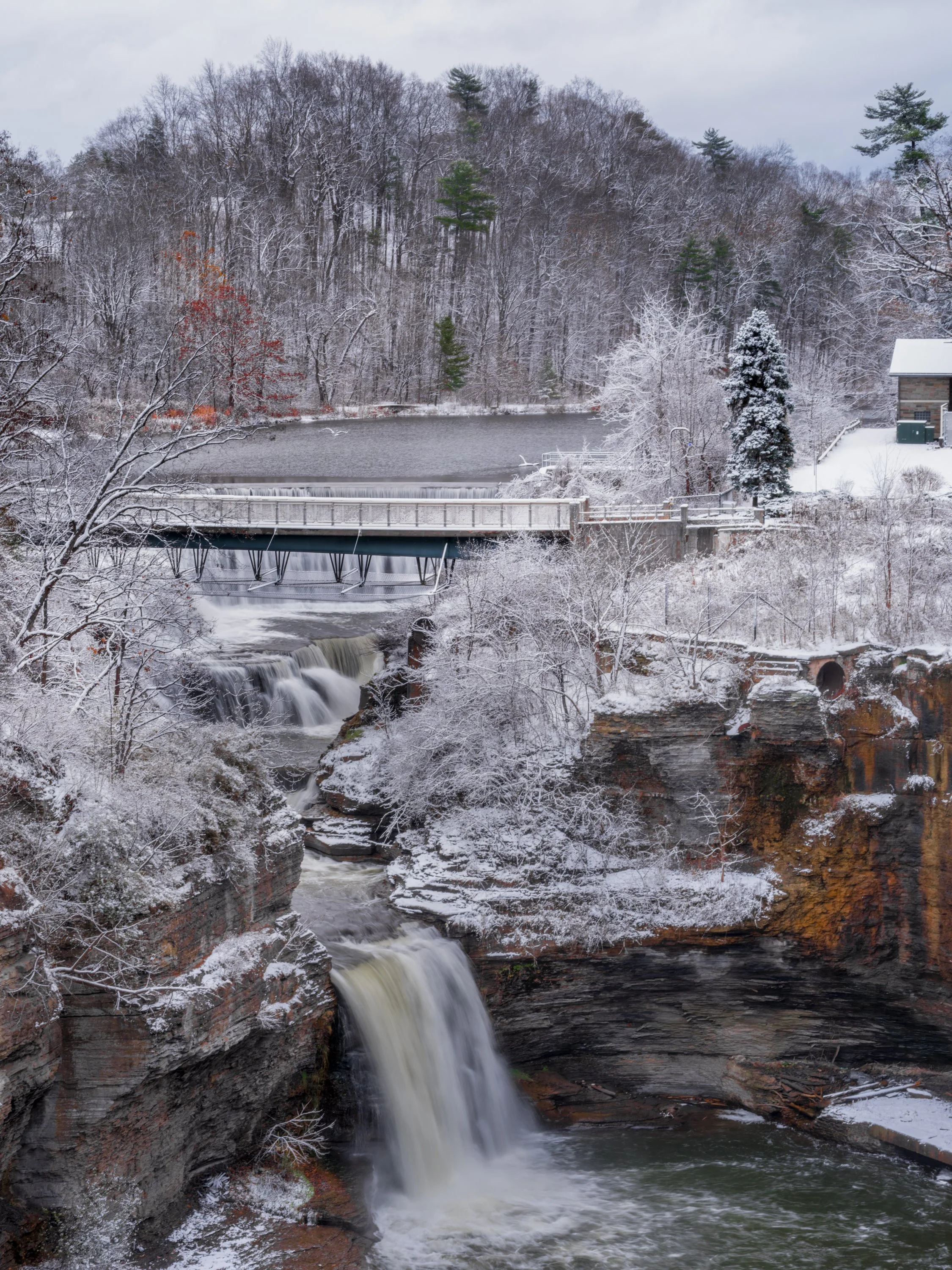
Beebe Lake at Cornell University
Geological Survey of New York, "Devonian Stratigraphy and Paleontology of the Cayuga Lake Basin", New York State Museum Bulletin (1981).
U.S. Geological Survey, "Surface-Water Water-Data Report: Fall Creek at Ithaca, NY", USGS Water Resources Data (2021).
American Society of Civil Engineers, "Ice Force Dynamics on Hydraulic Structures in Cold Regions", Journal of Cold Regions Engineering (2015).