Power, Erosion, and Climate Volatility at Horseshoe Falls
Horseshoe Falls is often viewed as an untouched spectacle, yet it functions as one of the most heavily engineered hydraulic systems on Earth. Draining four of the Great Lakes, Superior, Michigan, Huron, and Erie, the Niagara River acts as a continental hydrological bottleneck. Over 90% of its total discharge routes over Horseshoe Falls. Unregulated, this sheer volume drove aggressive headward erosion, undercutting soft Rochester shale beneath a hard Lockport dolomite caprock and retreating upstream at roughly three feet per year.
Today, that geomorphic timeline is artificially controlled. Under the 1950 Niagara Treaty, up to 75% of the river’s volume is diverted upstream into giant conduits feeding the Robert Moses and Sir Adam Beck hydroelectric stations. The International Control Works, an 18-gate weir spanning the river, dynamically regulates flow to satisfy statutory minimums for tourism (100,000 cubic feet per second during daylight hours in peak season; 50,000 cfs at night) while routing the remainder toward turbines. This diversion reduced erosion by roughly 85% while establishing a continuous 4.9-gigawatt source of low-carbon power.
However, climate change introduces severe hydrologic non-stationarity across the Great Lakes Basin. Rapidly shifting weather patterns, intense precipitation events, diminished winter ice cover, and fluctuating evapotranspiration rates have accelerated swings in Lake Erie’s surface elevations.
These hydrologic shifts turn Horseshoe Falls into a critical regional control valve. Real-time operation of the diversion gates allows water managers to damp regional discharge spikes, limit upstream shoreline erosion, and stabilize grid frequency during extreme thermal or weather events. Maintaining this balance requires navigating an inherent structural tradeoff: optimizing renewable energy production and flood mitigation against strictly mandated aesthetic flows in an increasingly volatile climate.
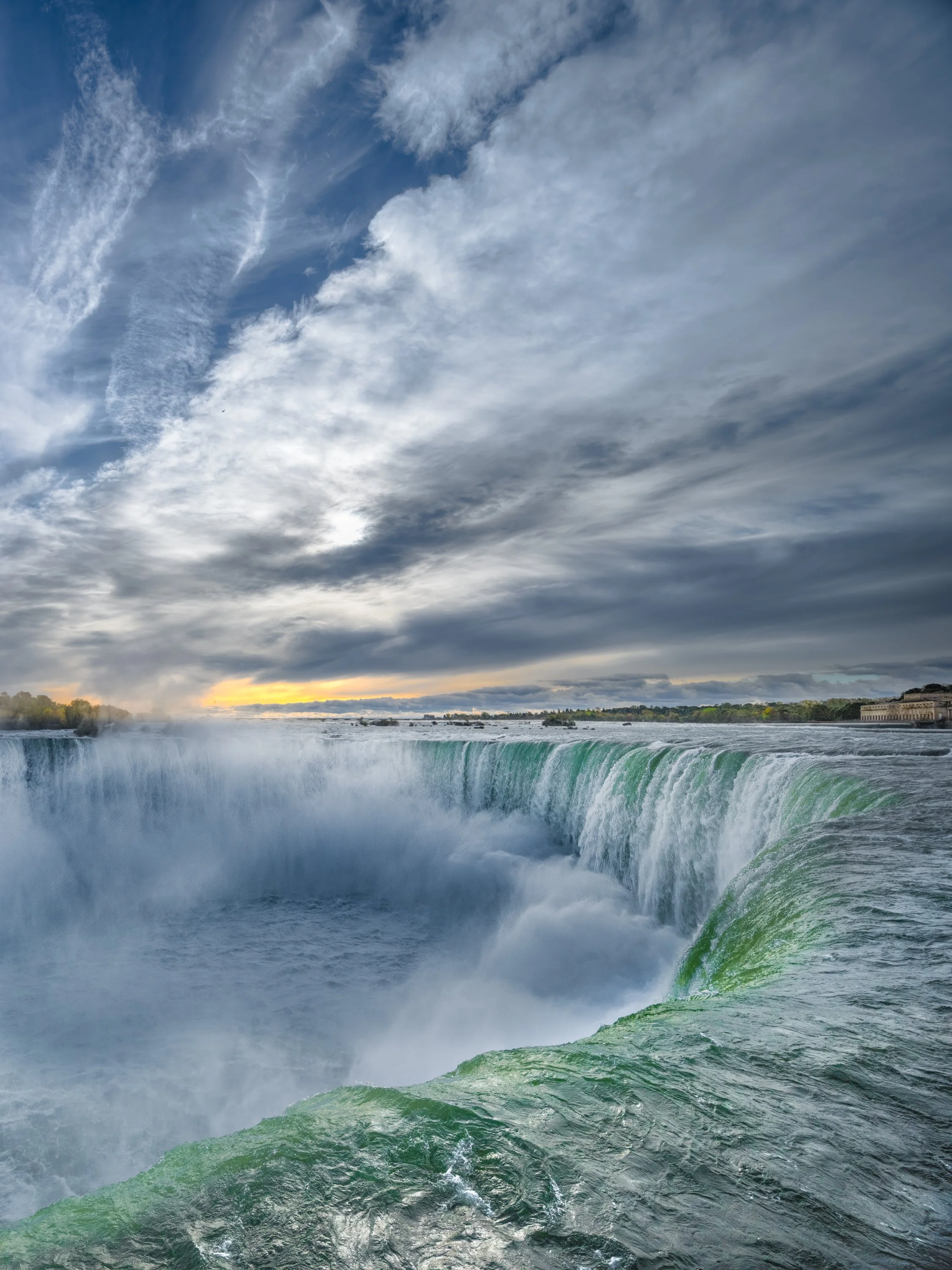
Horseshoe Falls from Ontario, Canada
Gronewold, A. D., & Rood, R. B. (2019). Recent rise in Great Lakes water levels exemplifies variability under climate change. Journal of Great Lakes Research, 45(1), 1–8.
International Joint Commission (IJC). (2021). Directive to the International Niagara Board of Control. International Joint Commission Technical Series.
Tinkler, K. J., Lorrain, J. P., & Stene, L. P. (1994). Postglacial recession rates of Niagara Falls in relation to water discharge and lake levels. Quaternary Research, 42(2), 190–204.
New York Power Authority (NYPA). Niagara Power Project (FERC No. 2216) Hydrologic and Hydraulic Flow Studies.