Deep Time and the Changing Bedrock
Four hundred million years ago, marine sediments accumulated to form the brittle Devonian shale beneath Ithaca. As the last ice sheets retreated during the late Pleistocene, massive volumes of glacial meltwater surged across the landscape, slicing through this soft bedrock to carve the narrow, steep-walled Cascadilla Gorge.
This rapid incision created a high-energy hydraulic gradient. Water drop along the gorge converted gravitational potential energy into immense kinetic force, driving continuous downstream scour.
In the early nineteenth century, settlers tapped into this thermodynamic system. Rather than altering the underlying geology, early industry constructed an upstream reservoir and raceway system to divert high-velocity runoff directly into waterwheels that powered local flour mills.
Decades after the industrial era, masons hand-cut local stone to line the gorge, creating the foot trail that weaves along the rock walls today. This stonework stabilized visitor access through an active channel where water, momentum, and erosion continually reshape the exposed bedrock.
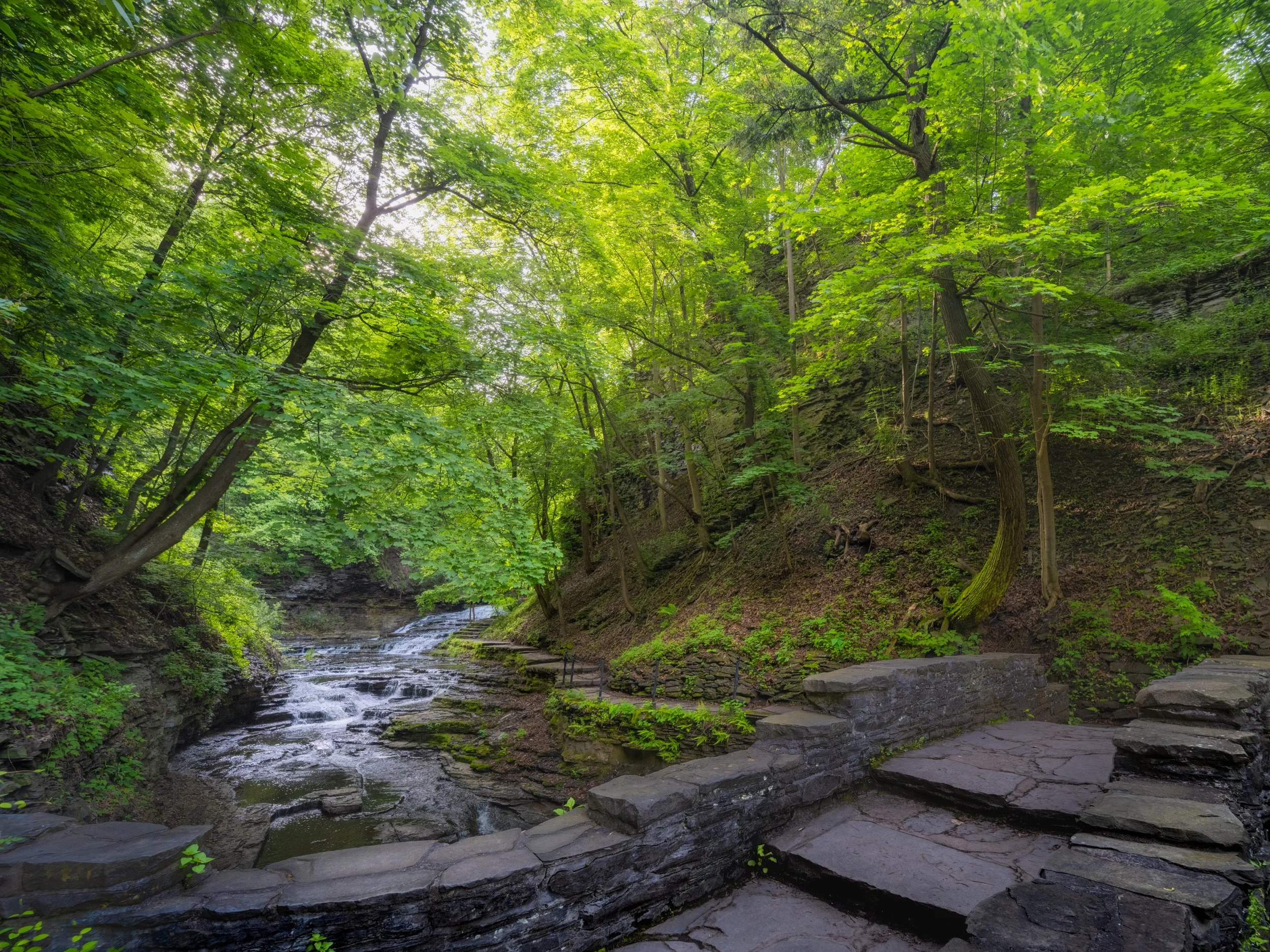
Cascadilla gorge trail in Ithaca, NY
USGS, Streamflow and Hydrologic Data for Cascadilla Creek at Ithaca, NY, U.S. Geological Survey Water-Data Report (2023). https://waterdata.usgs.gov/nwis
von Engeln, O. D., The Geology of the Ithaca Region, Cornell University Press (1961).
Fairchild, H. L., Glacial Waters in the Finger Lakes Region of New York, Geological Society of America Bulletin (1899). https://doi.org/10.1130/GSAB-10-27