Radiative Cooling and Valley Traps
Glaciers carved the deep Ithaca basin over hundreds of thousands of years, sculpting steep hills and a low valley floor. Today, that ancient topography acts as a massive fluid container.
As clear overnight skies radiate land heat directly into space, surface air chills rapidly. Because cold air is denser and heavier, it slumps downhill like a liquid under gravity, pooling at the bottom of the glacial trough.
When this descending pocket hits the dew point, ambient water vapor condenses, forming a thick river of radiation fog. Moisture ascending from warm Cayuga Lake collides with the cold air draining off forested slopes, driving a localized exchange of heat and atmospheric momentum.
While fluid dynamics shape the ground, optics dominate the sky. Low-angle morning sunlight must travel through a maximum depth of Earth's atmosphere to reach the valley.
This extended pathway amplifies Rayleigh scattering: air molecules scatter short blue wavelengths into deep space, allowing longer red, orange, and purple wavelengths to pass straight through. The result is a vibrant twilight spectrum suspended above a cold, trapped atmosphere, a transient optical phenomenon anchored by deep geological time.
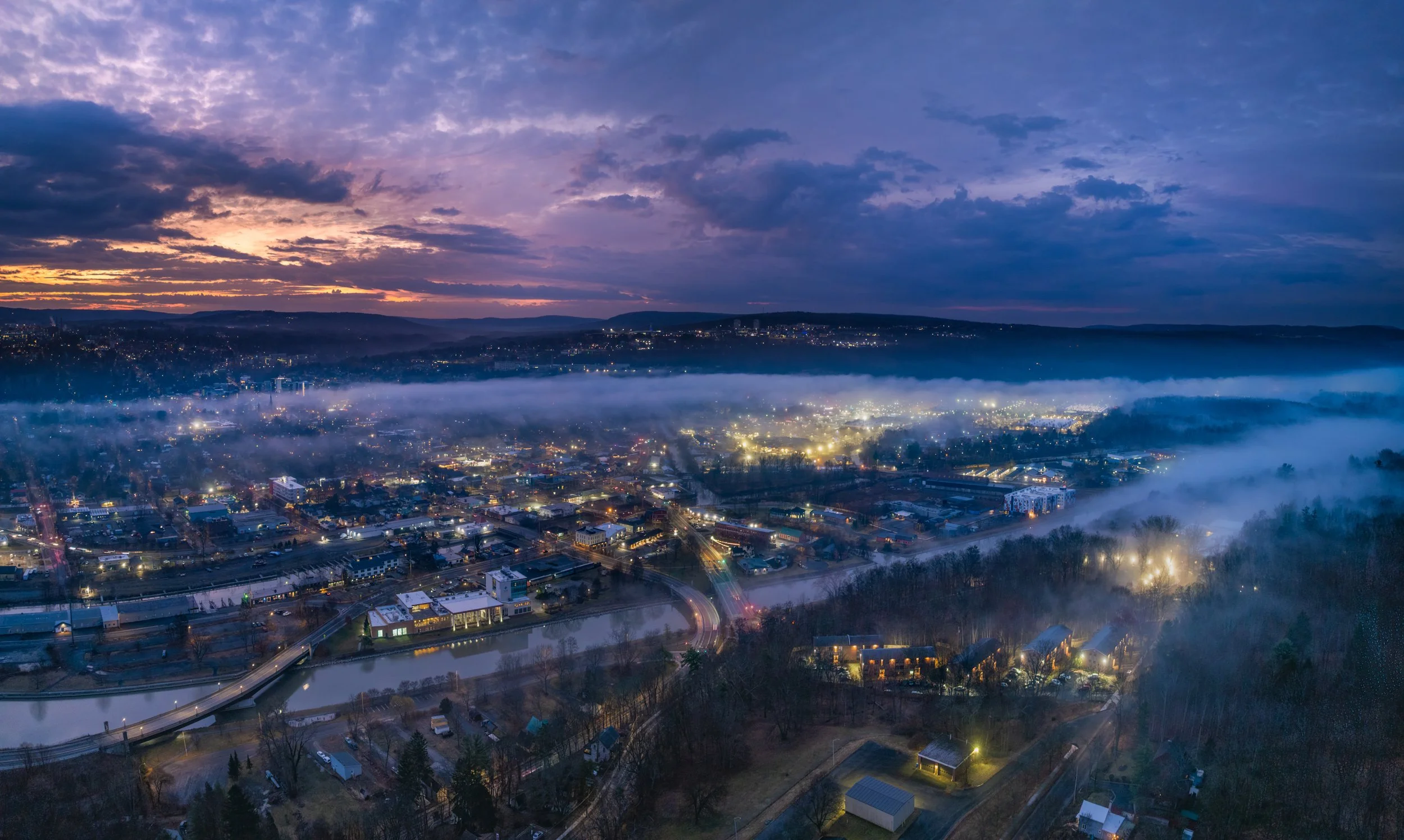
Early morning fog in Ithaca, NY
NOAA National Centers for Environmental Information, Radiation Fog Formation and Local Microclimates, NOAA Technical Memorandum NESDIS (2018). https://www.noaa.gov
Strutt, J. W. (Lord Rayleigh), On the Light from the Sky, Its Polarization and Colour, Philosophical Magazine, Vol. 41 (1871). https://doi.org/10.1080/14786447108640452
United States Geological Survey, Physiographic History of the Cayuga Lake Basin, USGS Professional Paper Series (2015). https://www.usgs.gov