A Landscape Driven by Physics
Taughannock Falls drops 215 feet—higher than Niagara—precisely because its foundation is fragile. Hundreds of millions of years ago, ancient sea mud compressed into soft shale, later capped by a veneer of dense sandstone. Taughannock Creek continuously scours this weak shale base, undercutting the cliff until massive rock slabs shear off under immense gravitational stress.
This isn't slow, uniform erosion; the gorge retreats in sudden, violent surges. In 1928, a single catastrophic rockfall sheared thousands of tons of brittle shale and sandstone off the overhang, overnight altering the amphitheater.
The river driving this collapse fluctuates wildly. During summer droughts, water trickles down to a few hundred gallons per minute, barely coating the rock face. During extreme floods, volume explodes to tens of thousands of gallons per second, transforming the creek into a massive hydraulic hammer that carves the gorge deeper.
As water plunges over the precipice, potential energy converts into thermal energy, theoretically warming the stream by a fraction of a degree. In reality, the violent impact shatters the stream into an aerosol mist. This dramatic surge in surface area accelerates rapid evaporation, drawing latent heat out of the air and cooling the basin below the temperature of the river above.
As dusk settles, Rayleigh scattering filters short blue wavelengths into deep zenith shadows while long red light ignites the horizon. Below, autumn unfolds on a shifting clock. Extended summer warmth delays leaf chlorophyll breakdown along the rim, pushing peak foliage deeper into October.
Simultaneously, the 215-foot gorge acts as a microclimatic buffer. Trapping lake-warmed air and humidity, the chasm cushions the surrounding forest canopy against sudden temperature swings, illustrating how local geology buffers regional climate shifts.
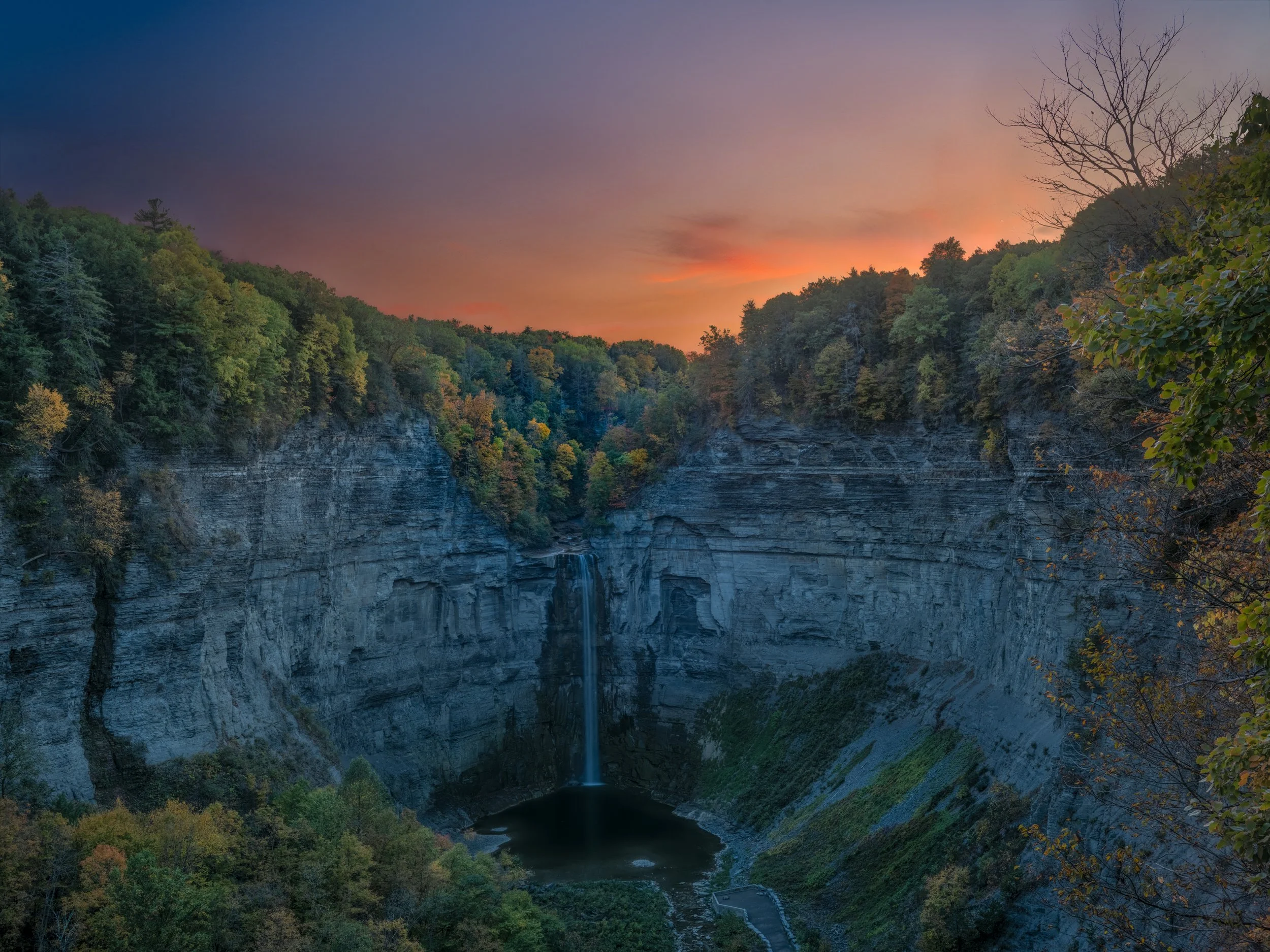
Taughannock Falls State Park, NY
Von Engeln, O. D., "The Geology of the Ithaca Region", Cornell University Press (1961).
U.S. Geological Survey, "Streamflow and Hydrologic Data for Taughannock Creek at Perry City, NY", USGS Water-Data Report (2022).
Philip, J. R., "Evaporation, and Moisture and Heat Fields in the Soil", Journal of Meteorology (1957).