The Late-Season Gambit
Deep in Central New York's forests, upper foliage filters out blue and red light, leaving understory plants submerged in dim, far-red wavelengths. Ground species like white snakeroot (Ageratina altissima) survive by capturing sunflecks—fleeting beams of direct sunlight that trigger rapid bursts of photosynthesis. Beneath the soil, mycorrhizal fungal networks link canopy trees directly to understory roots, exchanging minerals for photosynthetic sugars and transferring carbon to sustain blooms in deep shade.
Central New York averages thirty-eight inches of annual rainfall, far below the sixty-inch threshold of true temperate rainforests. However, low summer evaporation and persistent valley fog trap atmospheric moisture so efficiently that these deciduous forests mimic high-precipitation biomes. White snakeroot protects these hard-won moisture and energy investments with chemical defenses, synthesizing tremetol—a toxin that deters browsing deer and allows dense floral corridors to flourish undisturbed.
Flowering in mid-September presents a high-stakes trade-off against approaching frost. As the upper canopy thins, vital solar radiation finally pierces through to the forest floor. Extended warm autumns prolong this photosynthetic window, allowing late-blooming species to maximize late-season energy capture while supplying critical nectar reserves to migrating pollinators navigating shifting seasonal cues.
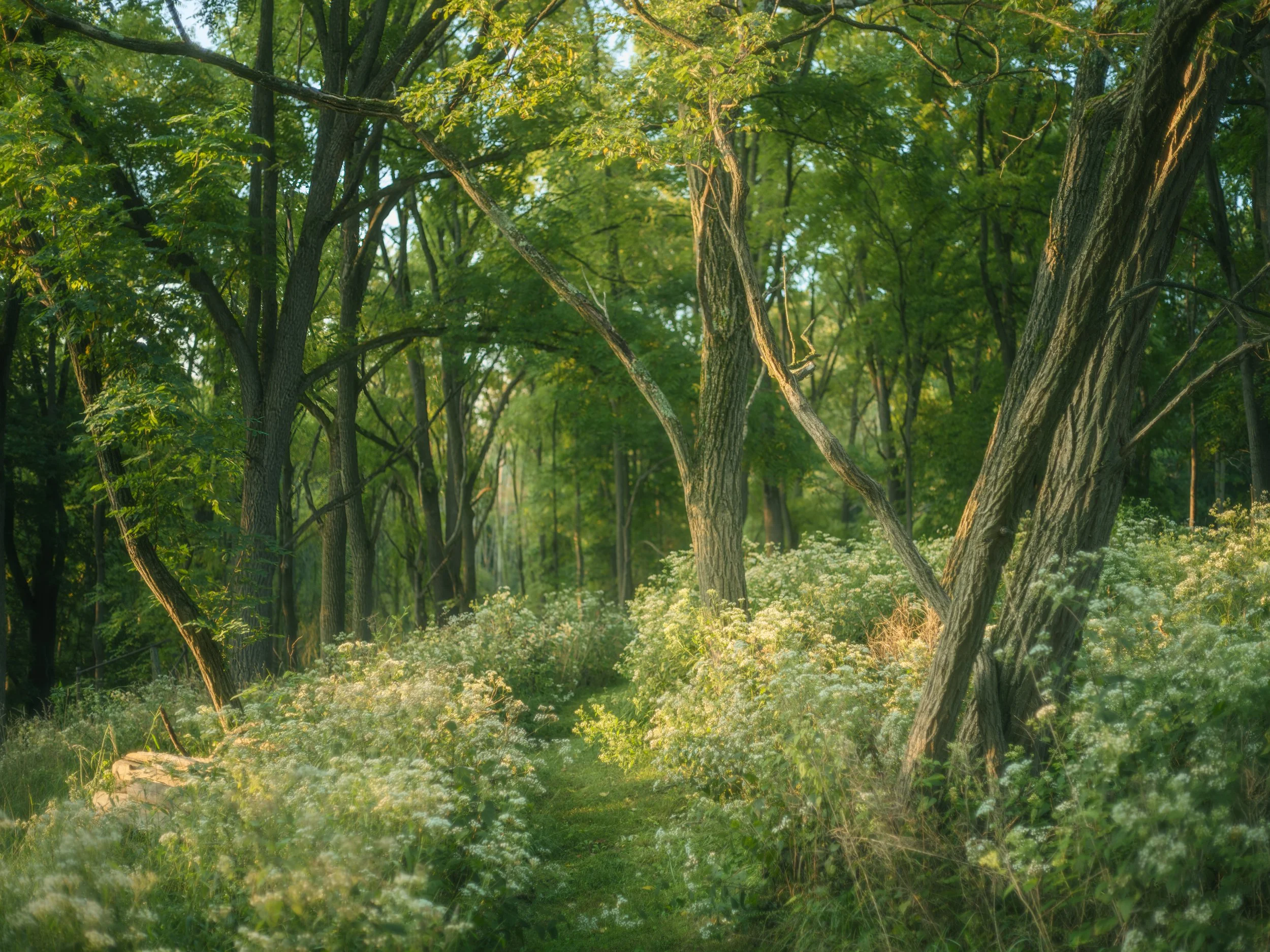
Upstate forest footpath Ithaca, NY
Pearcy, R. W., "Sunflecks and Photosynthesis in Plant Canopies", Annual Review of Plant Physiology and Plant Molecular Biology (1990).
Simard, S. W., Perry, D. A., Jones, M. D., Myrold, D. D., Durall, D. M., & Molina, R., "Net transfer of carbon between ectomycorrhizal tree species in the field", Nature (1997).
Couch, J. F., "The Toxic Constituent of Richweed or White Snakeroot (Eupatorium urticaefolium)", Journal of Agricultural Research (1928).