Biochemical Armor by Design
Suspended under the cover of timber rafters, garlic bulbs undergo a controlled drying process known as curing. As ambient air draws out moisture, the outer leaf sheaths desiccate into papery, protective wrappers. This rapid loss of water halts fungal pathogens and seals each clove inside a durable, dormant casing engineered to survive the winter.
That dormancy relies entirely on the cold. Hardneck garlic varieties cultivated across Central New York require vernalization, a prolonged exposure to freezing soil temperatures, to signal the plant to split into individual cloves come spring. Without this winter chill, the subterranean bulb remains a single, undivided unit.
While hanging, the intact garlic bulb remains virtually odorless. It locks away two inert chemical precursors: the amino acid derivative alliin and the enzyme alliinase. Separated inside distinct cellular compartments, these molecules wait in stasis until an invading herbivore or crushing force tears the cell walls open.
When ruptured, alliin and alliinase mix instantly to synthesize allicin, a volatile organosulfur compound. Allicin generates the sharp, pungent aroma we recognize, acting as a natural chemical weapon designed to neutralize soil fungi and deter herbivores the moment physical damage occurs. Leaving the stalks attached while curing lets fluid transport taper gradually, perfecting this biochemical armor before the bulb enters extended dormancy.
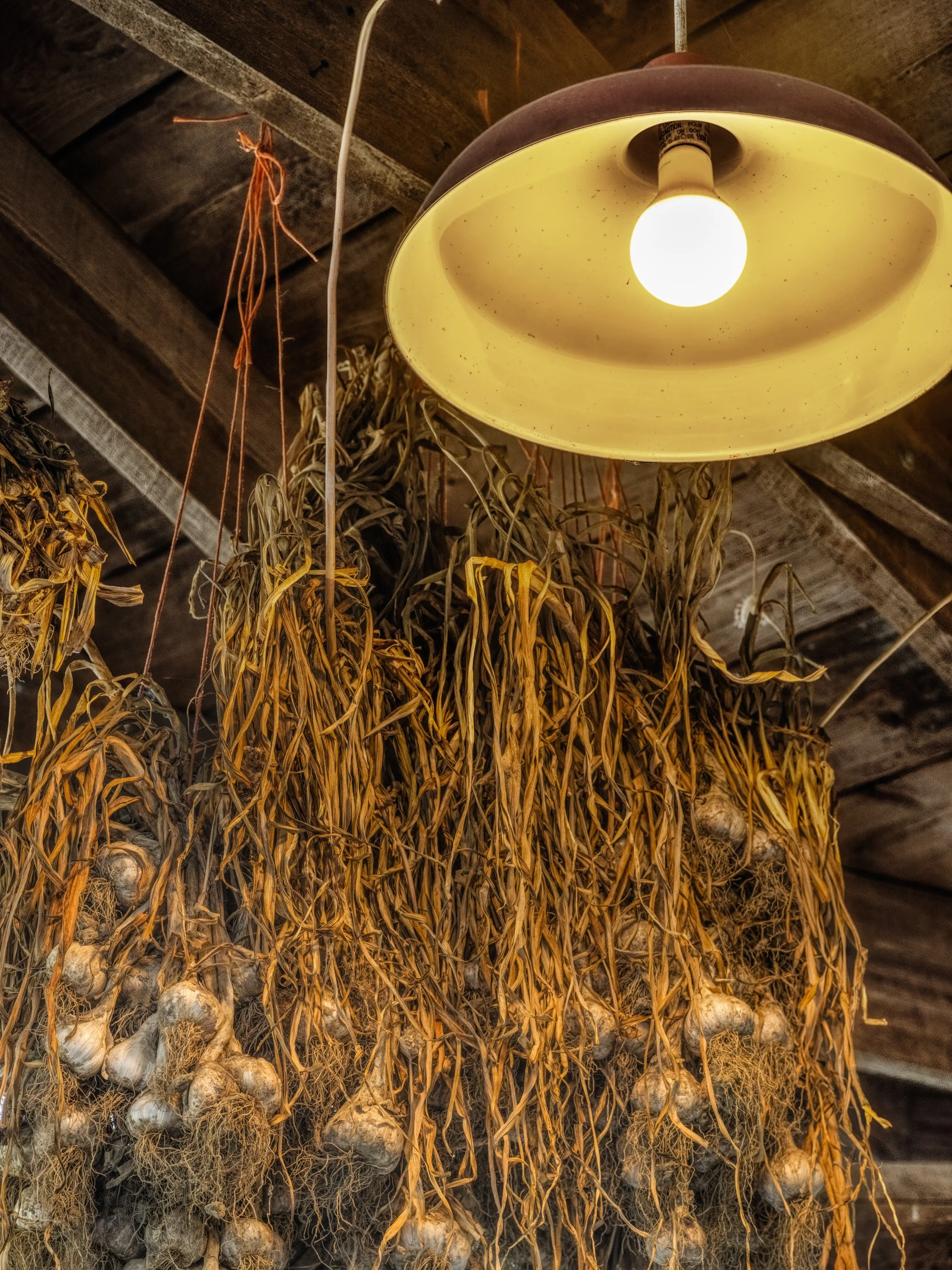
Curing garlic at Indian Creek Farms near Turmansburg, New York
Block, E., "The Chemistry of Garlic and Onions", Scientific American (1985).
Cavallito, C. J., & Bailey, J. H., "Allicin, the Antibacterial Principle of Allium sativum. I. Isolation, Physical Properties and Antibacterial Action", Journal of the American Chemical Society (1944).
Kamennac, A., & Kamenetsky, R., "Garlic (Allium sativum L.): Botany, Physiology, and Eco-Physiology", Floriculture, Ornamental and Plant Biotechnology (2006).