The Underground Battery
Even during weeks of scorching midsummer drought, Cascadilla Creek never runs dry. The stream’s persistence relies on the porous soil and fractured Devonian shale layer sitting high above the gorge. Water from past seasons percolates slowly through these subterranean networks, creating a hidden hydraulic battery that continuously releases a baseline flow through deep bedrock fractures.
The gorge’s dramatic verticality is the result of a sudden geological shift. Roughly 12,000 years ago, massive mile-thick ice sheets retreated, gouging out deep, overdeepened main valleys like the Cayuga basin. This left smaller tributary streams hanging hundreds of feet above the valley floor.
Driven by gravity, the stream cut rapidly into the exposed bedrock to find equilibrium. The distinct stepped ledges reflect the structural physics of the region: brittle, ancient marine sediments snap along pre-existing vertical fracture lines, popping off in flat, clean slabs rather than eroding into smooth slopes.
Shifted atmospheric patterns increasingly favor intense, concentrated storm events over steady rainfall. In this evolving regime, Cascadilla Gorge operates as a high-capacity transducer, converting immense gravitational potential energy into physical work.
During heavy downpours, powerful episodic flush cycles blast loose shale downstream and actively re-sculpt the bedrock layout. The surrounding ecosystem continually reorganizes around these volatile hydraulic surges, adapting to a landscape defined by rapid mass transfer rather than static equilibrium.
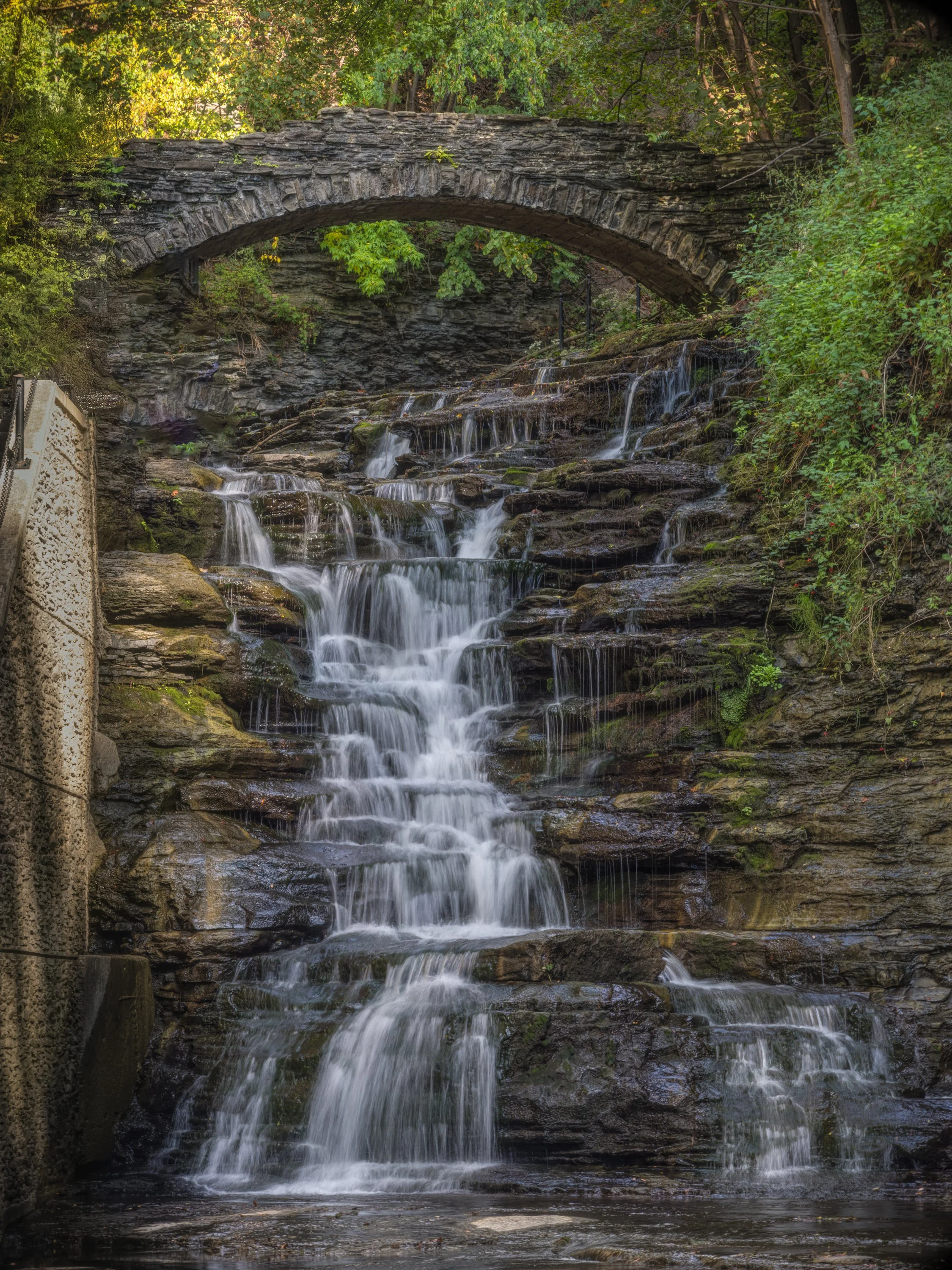
Cascadilla Creek in Ithaca, NY
von Engeln, O. D., "The Finger Lakes Region: Its Origin and Nature", Cornell University Press (1961).
Miller, A. J., & Miller, N. G., "Postglacial Erosion Rates and Bedrock Channel Evolution in Central New York", Geological Society of America Bulletin (1997).
U.S. Geological Survey, "Streamflow Dynamics and Groundwater-Surface Water Interactions in Cayuga Lake Tributaries", USGS Water-Resources Investigations Report (2018).