The River That Refused to Move
Standing at the rim of the Black Canyon, it is tempting to imagine a sudden tectonic tear ripping open the Earth to let the river through. The physical reality is far more counter-intuitive: the Gunnison River was already there.
Around 15 million years ago, as deep tectonic forces began slowly warping the crust upward to create the Gunnison Uplift, the river refused to change course. Instead, it functioned like a fixed vertical saw operating on a conveyor belt of rising stone.
As the surrounding plain rose, the river's high gradient and abrasive sediment continuously ground downward, maintaining its path and slicing through thousands of feet of volcanic ash and sedimentary layers.
At the canyon floor, the river eventually struck the rigid basement of the North American continent: a complex assembly of 1.7-billion-year-old metamorphic rock, predominantly dark schist and banded gneiss.
These crystalline rocks did not originate near the surface. They were cooked and forged under immense heat and shear stress roughly twelve miles beneath an ancient mountain range during the Proterozoic Era.
What makes this exposure remarkable is not just its age, but the profound structural gap it exposes. Resting directly on top of this 1.7-billion-year-old basement rock are much younger sedimentary deposits, leaving a gap of roughly a billion years in the rock record—a dramatic regional instance of the Great Unconformity.
The sheer, dark walls reveal the deep structural roots that anchor the continent, offering a rare look at how continental crust reorganizes, cools, and stabilizes over deep time.
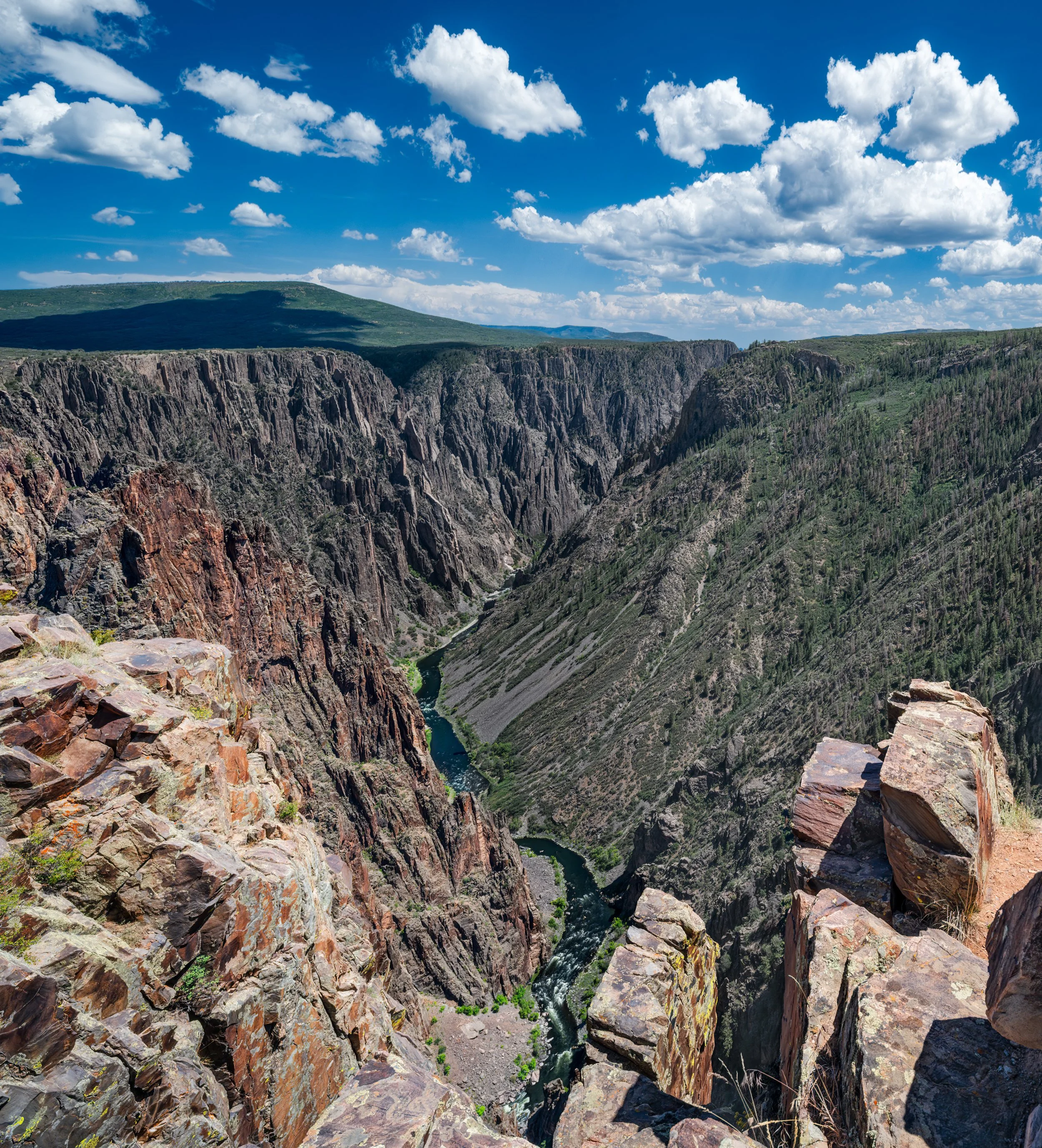
The Black Canyon of the Gunnison
Hansen, W. R., "Geology of the Black Canyon of the Gunnison, Colorado", U.S. Geological Survey Bulletin 1191 (1965).
Karlstrom, K. E., et al., "Proterozoic growth of North America", GSA Today (1999).
Aslan, A., et al., "Late Cenozoic river incision and evolution of the Upper Colorado River System", Geosphere (2014).