SWhen midsummer heat parches the smaller gorges of the Finger Lakes, turning neighboring streams into dry gravel beds, water still thunders down the 150-foot face of Ithaca Falls. This perpetual plunge is driven by an unseen subterranean reservoir. Fall Creek drains a massive 126-square-mile upland watershed, where layers of porous glacial till store vast volumes of groundwater. As the water slowly filters through subterranean channels, it steadily feeds the river year-round, buffering the cataract against seasonal drought.
Along the sheer shale walls flanking the main cascade, this underground hydrology creates hidden sanctuaries. Water leaks directly out of bedrock micro-fissures, forming perpetually wet cliff faces. These micro-seeps act as climate-buffered oases. Cooled by continuous evaporation and shielded from extreme temperature swings, these mist-drenched rocks support rare mosses, delicate ferns, and specialized invertebrates that cannot survive in the surrounding forest.
This relentless hydrological engine also forged the economic bedrock of the region. In the 19th century, while competing mills along smaller local creeks were forced to shut down during summer dry spells, Fall Creek offered an unbroken supply of kinetic energy. Millers tunneled through solid rock to tap its high-pressure flow for flour, plaster, and wool production. A young Ezra Cornell managed these water rights, using his engineering success on Fall Creek to build the financial foundation that eventually helped launch Cornell University.
By 1883, the Ithaca Gun Company anchored its operations on the gorge cliff face directly above the falls. For over a century, waterwheels driven by Fall Creek powered precision machinery, turning out world-famous firearms for icons like Annie Oakley and supplying defense contracts through two World Wars. The enduring flow of Fall Creek did not just carve a gorge—it powered an industrial empire and built a university.
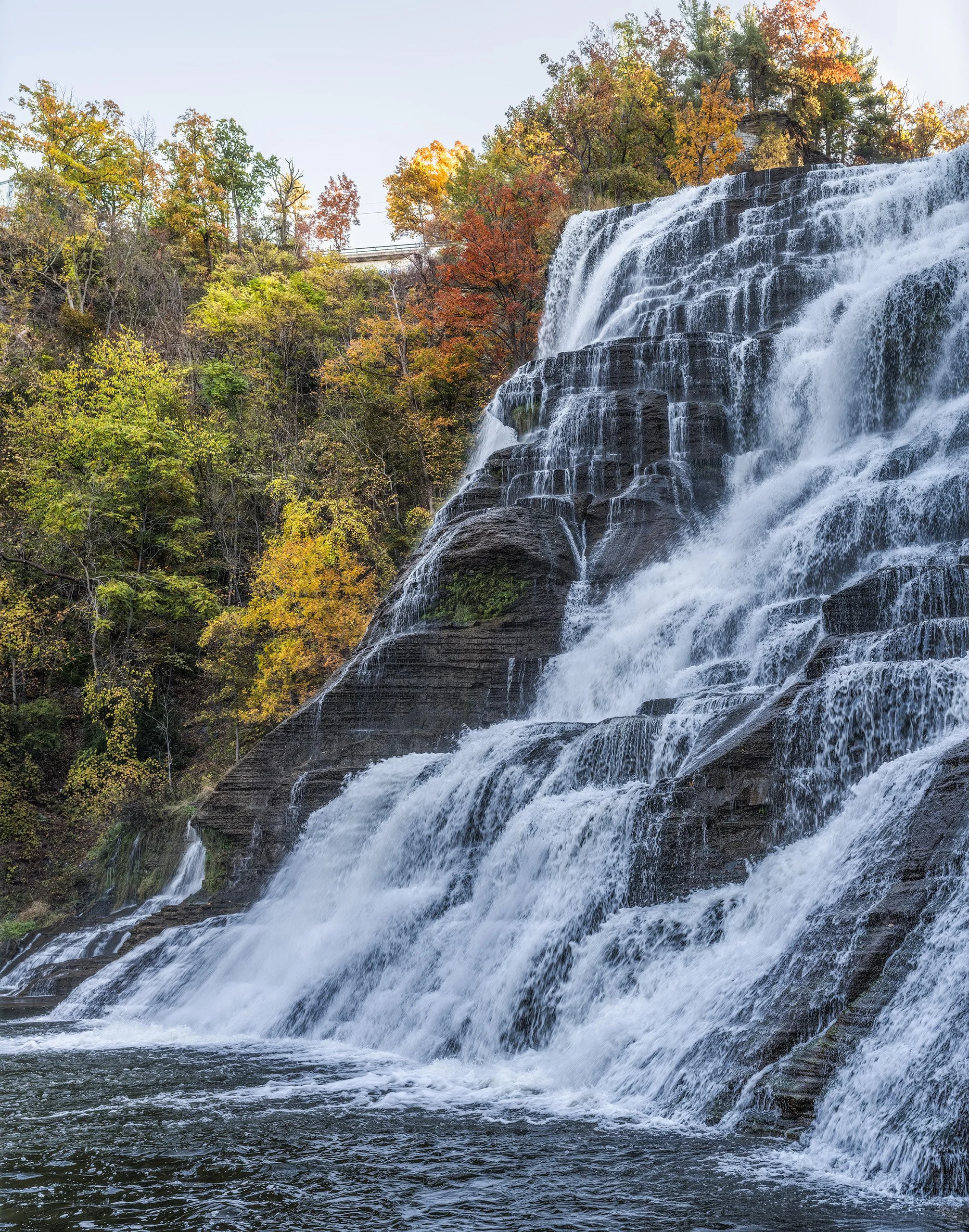
Ithaca Falls on Fall Creek in Ithaca, New York
United States Geological Survey, "Streamflow and Groundwater Interactions in the Glaciated Finger Lakes Basin", USGS Water-Resources Investigations Report (2018).
von Engeln, O. D., "The Geology of the Ithaca Region: Glacial Sculpting and Drainage Evolution", Cornell University Press (1961).
Carol, J. A., & Bouldin, D. R., "Hydrogeology and Surface Water Quality of the Fall Creek Watershed", Journal of Environmental Quality (1985).