Standing beneath the high-altitude canopy on the slopes of Mauna Loa, the atmosphere operates on overlapping scales of time, chemistry, and planetary energy. The eerie, luminous sky overhead is not light pollution or an aurora, but atmospheric airglow. During the day, intense solar ultraviolet radiation splits oxygen molecules high in the upper atmosphere. When darkness falls, those isolated atoms recombine, releasing chemiluminescent energy that bathes the high-elevation ground fog in a faint green and golden light.
Below that nocturnal sky, the dark silhouettes of century-old Acacia koa trees mark a landscape radically altered by shifting climate dynamics. These old-growth canopy giants—some over 200 years old—grew within protected high-altitude kīpuka, or forest sanctuaries spared by historical lava flows. Historically, high-elevation koa ecosystems experienced fire only once every few centuries, as the surrounding native rainforest kept understory fuels damp and ignition sources virtually non-existent. Because koa evolved without thick, insulating bark or other fire adaptations, these ancient trees were vulnerable when those moisture barriers collapsed.
The August 2018 Keauhou Fire demonstrated how regional climate shifts are rewriting local fire regimes. An extraordinarily wet winter in 2017–2018 triggered a burst of growth in invasive, non-native pasture grasses across Mauna Loa. As summer set in, acute drought conditions dried that dense vegetation into a volatile fuel bed.
This rapid drying reflects a broader atmospheric trend across the Hawaiian Islands. University of Hawaiʻi research shows that trade-wind patterns are changing, causing the high-altitude trade-wind inversion layer to frequently descend and lock into place. This cap prevents moisture-laden marine air from rising, trapping upper-elevation forests—like the 6,000-foot koa zone—in prolonged periods of desiccation. When a single spark from a bulldozer hit the cured grass, it ignited a hot surface fire that destroyed 3,700 acres of ancient forest.
Adding to the surreal scene, the subterranean Earth was undergoing its own dramatic transformation. In May 2018, the long-standing lava lake inside Kīlauea's summit crater, Halemaʻumaʻu, drained rapidly into the lower East Rift Zone. The emptying chamber triggered an unprecedented summit collapse, marked by roughly 60 magnitude-5+ earthquakes that shook the caldera. The summit's iconic red glow went completely dark for over two years until fresh magma finally breached the crater floor once again, casting a resurrected crimson light against the night fog and the core of the Milky Way.
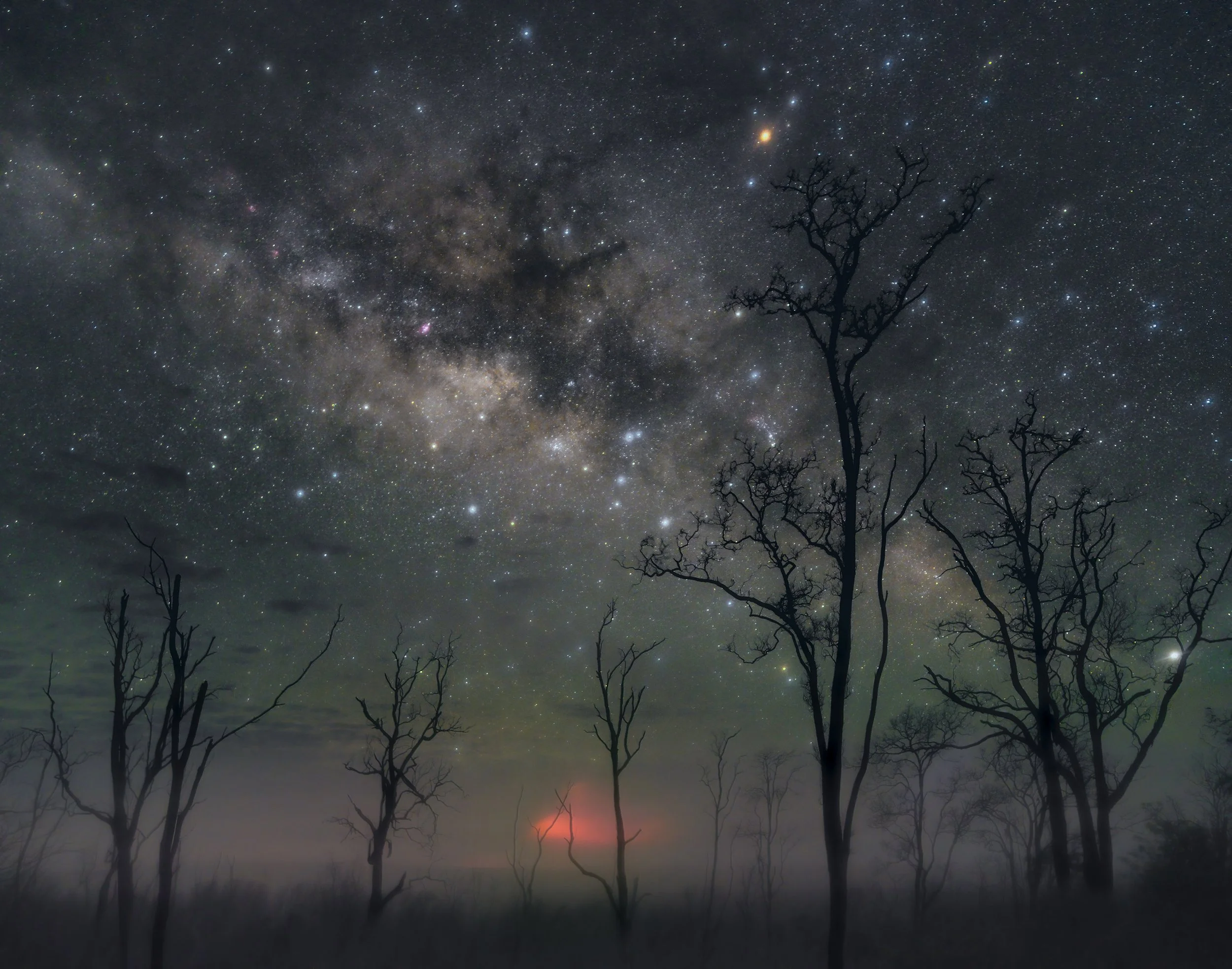
Koa forest at Hawaii Volcanoes National Park
Neal, C. A., et al., "The 2018 rift eruption and summit collapse of Kīlauea Volcano", Science (2019).
Trauernicht, C., et al., "The Contemporary Scale and Context of Wildfire in Hawaiʻi", Pacific Science (2015).
Diaz, H. F., et al., "Climatic Changes in the Hawaiian Islands: Overview of Recent Research", IPCC Regional Climate Dynamics (2016).