The Vanishing Archive: Icelandic Glaciers and the Global Climate Engine
To the casual observer, the colossal ice cap framed against southern Iceland’s volcanic peaks looks static—a permanent feature of the subpolar landscape. Yet glaciers are dynamic, fluid structures operating as both atmospheric archives and critical regulators of Earth’s climate system.
A Disappearing Atmospheric Record
Glacial ice acts as a natural time capsule. As snow falls and compacts into ice over centuries, it traps tiny bubbles of ancient atmosphere, preserving a direct proxy record of historical atmospheric composition and ambient temperatures. However, anthropogenic warming has shifted Icelandic glaciers into a regime of rapid mass loss. Since the late 19th century, Iceland’s ice caps have lost roughly 16% of their total mass, with nearly half of that loss occurring after 1994 (Aðalgeirsdóttir et al., 2021). As these ice fields melt, we lose not only vital freshwater reserves but also the physical archives needed to reconstruct paleoclimate baseline dynamics.
Ocean Circulation and Tipping Points
Despite sitting near the Arctic Circle, Iceland enjoys a relatively mild climate due to the poleward transport of heat via the Atlantic Meridional Overturning Circulation (AMOC)—the ocean’s primary thermal conveyor belt. As glaciers melt, they discharge enormous volumes of fresh meltwater into the salty North Atlantic. Freshwater reduces seawater density at high latitudes, inhibiting the deep convection that drives this circulation. This influx risks weakening the AMOC or triggering non-linear tipping points, which could locked-in severe, multi-century climate shifts across the Northern Hemisphere (Castellana & Dijkstra, 2020).
The Albedo Feedback Loop
The localized retreat visible in this image contributes directly to planetary-scale climate feedbacks through the albedo effect. Pristine glacial ice reflects up to 80% of incoming solar radiation back into space. As warming temperatures melt the ice cover and expose the dark volcanic bedrock beneath (Belart et al., 2020), the land absorbs significantly more thermal radiation. This self-reinforcing feedback loop accelerates local melt rates and contributes to global sea-level rise, illustrating how regional cryospheric changes cascade into global climate disruption.
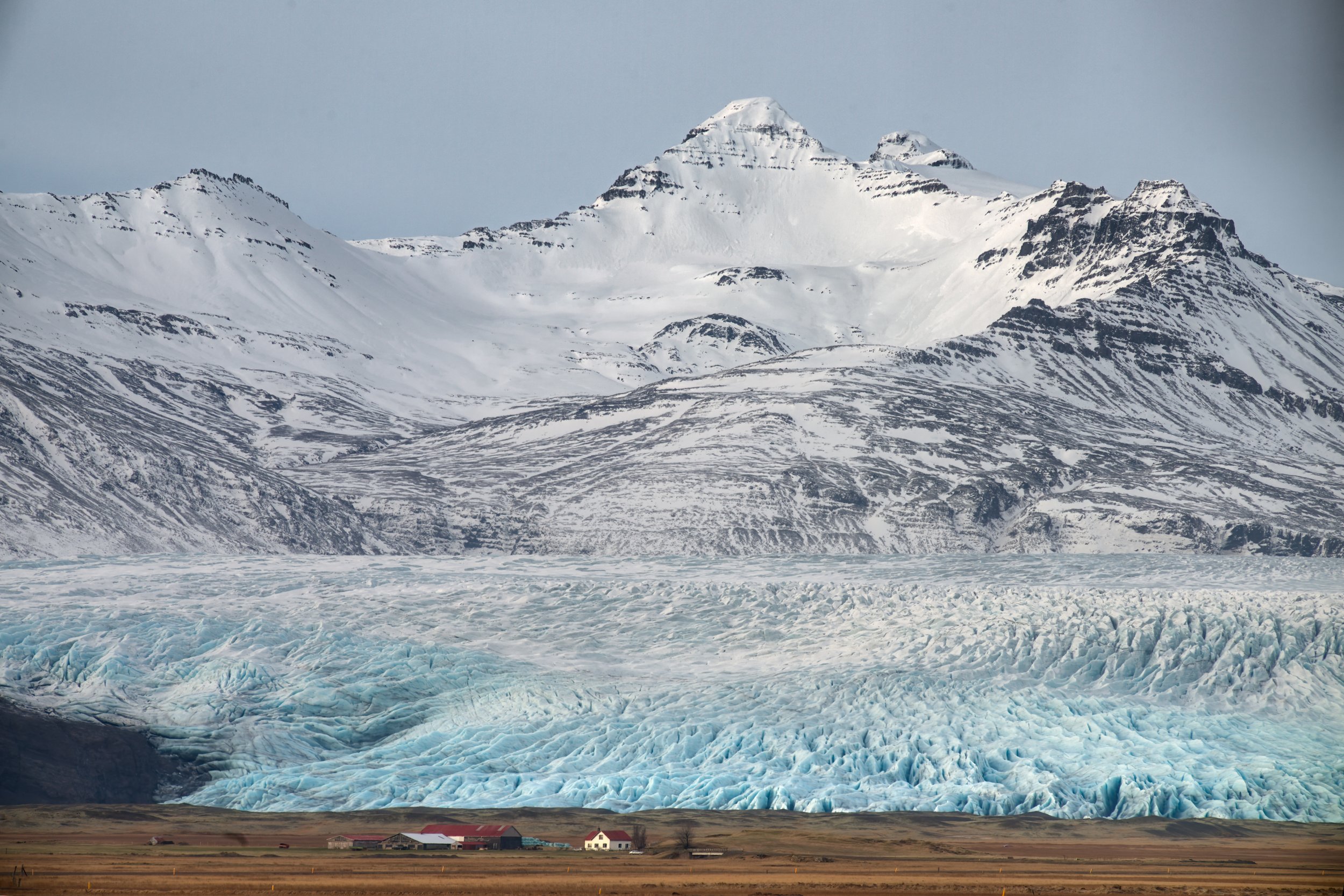
Homestead in southern Iceland
Aðalgeirsdóttir, G., Magnússon, E., Pálsson, F., et al. (2021). Glacier Changes in Iceland From ~1890 to 2019. Frontiers in Earth Science. https://doi.org/10.5194/egusphere-egu21-15926
Belart, J. M. C., Magnússon, E., Berthier, E., et al. (2020). Mass Balance of 14 Icelandic Glaciers, 1945–2017: Spatial Variations and Links With Climate. Frontiers in Earth Science, 8. https://doi.org/10.3389/feart.2020.00163
Castellana, D., & Dijkstra, H. A. (2020). Noise-induced transitions of the Atlantic Meridional Overturning Circulation in CMIP5 models. Scientific Reports, 10(1). https://doi.org/10.1038/s41598-020-76930-5