The Hidden Geometry of Scale
While Mount Everest claims Earth's highest altitude, Mauna Loa reigns supreme in total scale. The volcano’s immense mass actually depresses the Pacific Plate five miles into the mantle. Measuring from its subterranean root to its summit yields a staggering total height of roughly 53,000 feet, dwarfing every other terrestrial mountain on Earth.
In late 2022, Mauna Loa awoke from a 38-year slumber. Driven by pressurized magma breaching its Northeast Rift Zone, the 12-day eruption erupted over 200 million cubic meters of basaltic lava. Cresting the upper vents at roughly 2,100°F (1,150°C), this low-viscosity basalt forms a self-insulating crust. Liquid rivers inside subterranean lava tubes lose minimal heat, allowing molten rock to travel miles downslope while remaining near eruption temperature.
Sampling Earth’s Atmosphere Above the Plumes
Perched high on the volcano's northern flank at 11,135 feet, the Mauna Loa Observatory produces the Keeling Curve, the foundational record of global atmospheric carbon dioxide. Observing pristine air here requires isolating sensitive equipment from local volcanic degassing.
A persistent subtropical trade-wind inversion acts as a atmospheric lid around 6,000 to 8,000 feet. This temperature inversion traps lower-level volcanic gases beneath a stable air mass, allowing summit sensors to sample well-mixed marine air. Even during major active eruptions, meteorological dynamics isolate the observatory, protecting humanity's baseline climate dataset from local contamination.
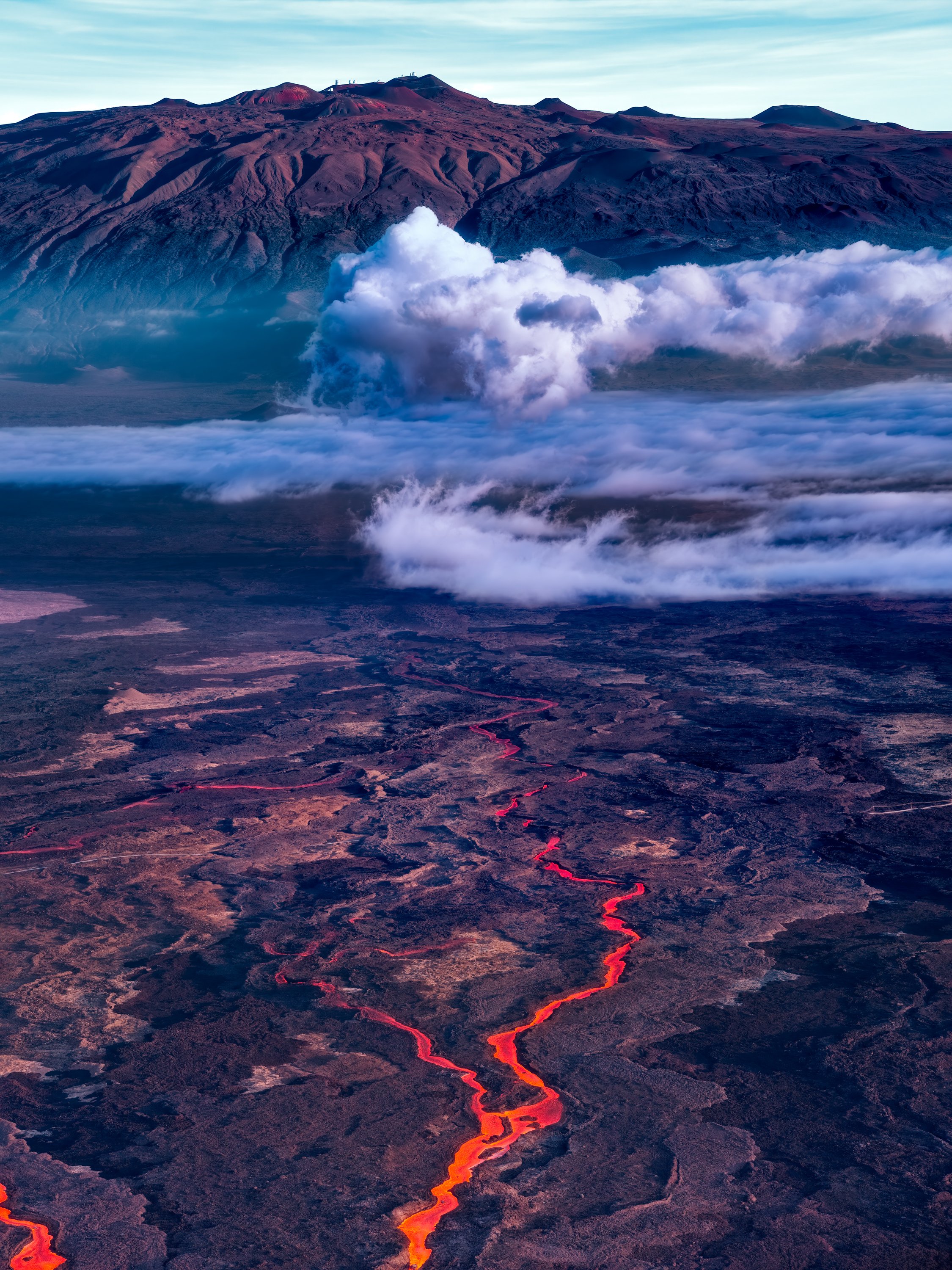
2022 Mauna Loa eruption on Hawaii Island
USGS Hawaiian Volcano Observatory, "Preliminary Summary of the 2022 Mauna Loa Eruption", U.S. Geological Survey (2023).
Keeling, C. D., et al., "Exchanges of Atmospheric CO2 and 13CO2 with the Terrestrial Biosphere and Oceans from 1978 to 2000", SIO Reference Series (2001).
Garcia, M. O., et al., "Mauna Loa Progress Report: Magmatic Processes and Volcanic Hazards", AGU Geophysical Monograph Series (1995).