The Architecture of Hydraulic Force
380 million years ago, mud and fine silt settled in a quiet Devonian sea, eventually hardening into paper-thin layers of brittle shale. Tectonic collisions later fractured these sedimentary strata, creating a massive grid of vertical stress joints throughout the bedrock.
During the last Ice Age, mile-thick continental glaciers gouged out the deep, U-shaped Seneca Lake basin. This massive ice sheet left tributary streams like Glen Creek stranded as high-elevation "hanging valleys" perched far above the newly lowered valley floor.
For 12,000 years, gravity has driven Glen Creek to bridge that height difference. Water wedged hydraulic leverage directly into the ancient joint fractures, breaking off rock in geometric blocks. In the plunge pools below, swirling eddies turn sand and gravel into natural drill bits that scour deep circular basins, constantly undermining the ledges above.
This ongoing destruction accelerates every winter. Water seeps into shale crevices, expands as ice, and violently snaps the stone. Spring runoff sweeps this debris into Seneca Lake, continually reshaping the gorge in an uninterrupted display of kinetic landscape evolution.
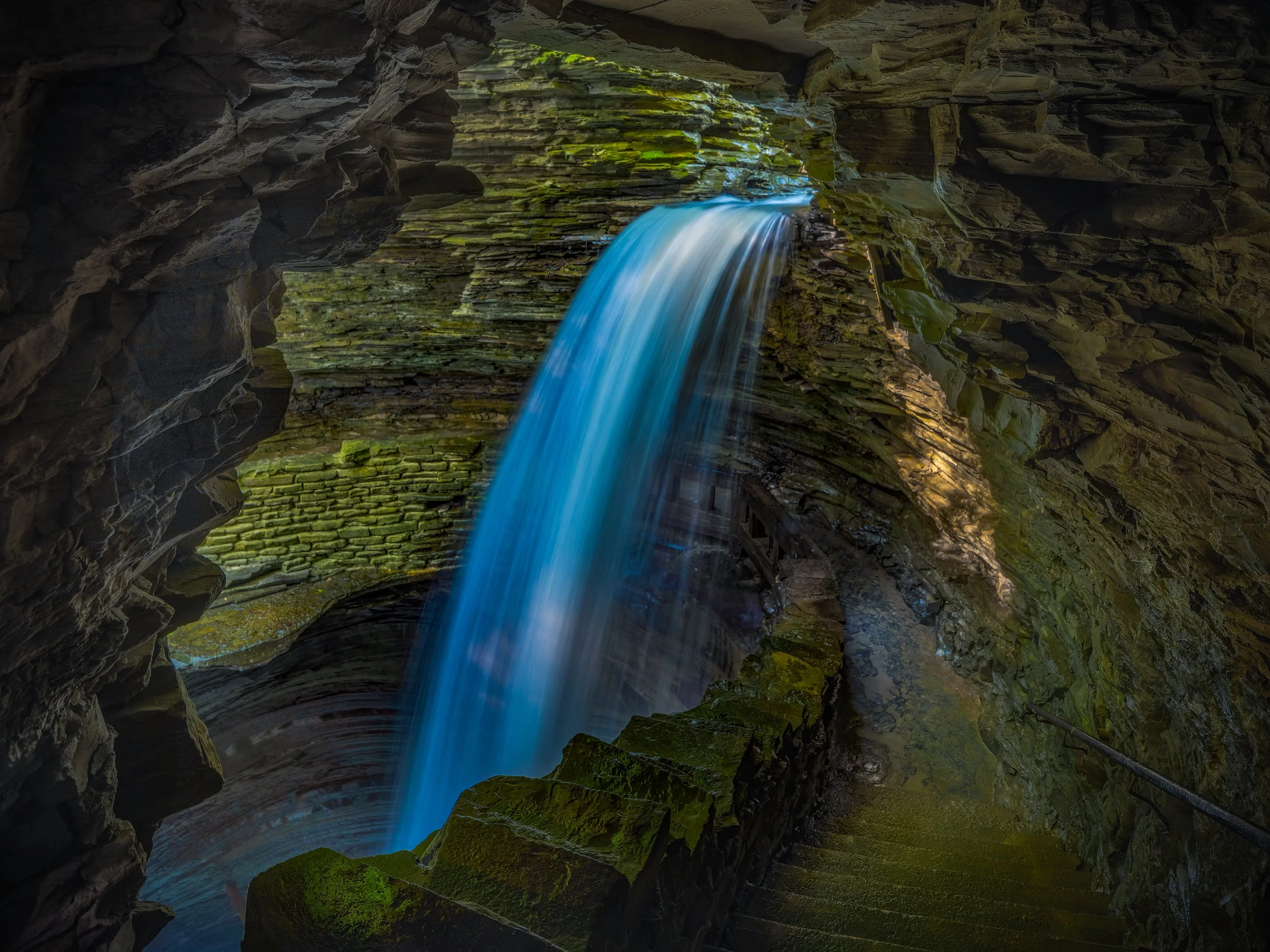
Cascade Falls in Watkins Glen, NY
Muller, E. H., & Calkin, P. E. (1993). Late Pleistocene Glaciation and Stratigraphy in Western New York. Geological Society of America Bulletin. https://nysl.ptfs.com/aw-server/rest/product/purl/NYSL/s/cc34d1bb-23d3-489b-99d3-6e654cdcb844
Engeln, O. D. von. (1961). The Finger Lakes Region: Its Origin and Nature. Cornell University Press.
United States Geological Survey (USGS). Geology and Glacial History of the Finger Lakes Region, New York. USGS Educational Publications. https://www.usgs.gov